Buying Guide
5 Sided Bay Window Curtain Track
Yes, I make made-to-measure curtain tracks for five-sided bay windows, with every bend shaped to match your individual bay.
But before choosing your track, there’s one important thing worth checking.
Some bay windows, particularly those found in 1930s houses, look five-sided around the windows but have a different shape below the window sill.
That difference, along with the depth of your window sills and the length of your curtains, can affect which track arrangement will work best.
I’ll show you how to recognise the difference and find the right guide for your window.
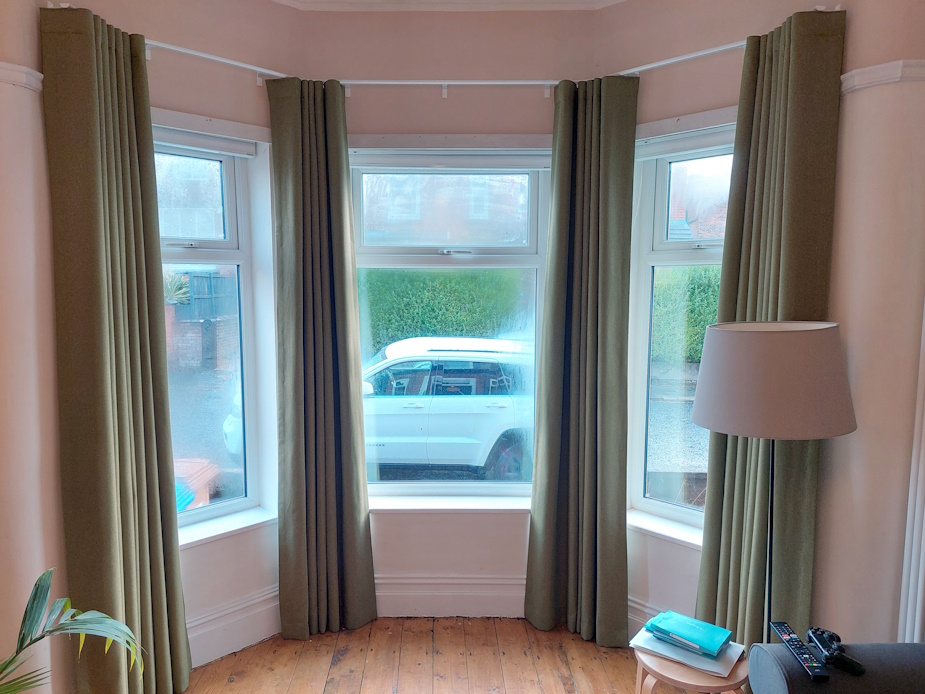
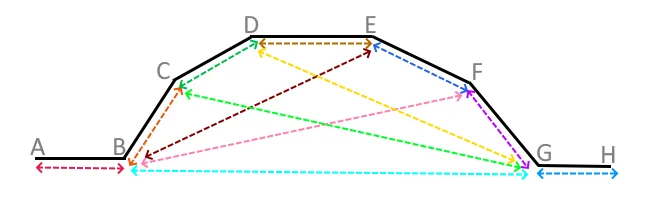
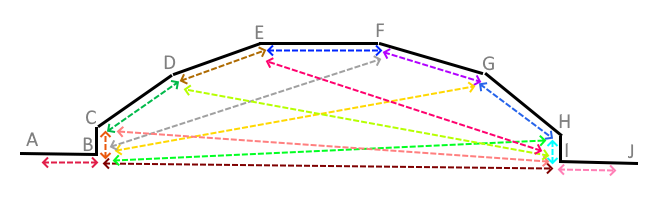
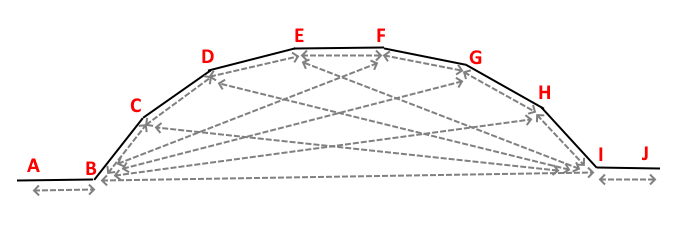
A typical five-sided bay has three windows and two narrower wall sections at the sides.
What Is a 5 Sided Bay Window?
A typical five-sided bay has three windows: one across the front and two sloping side windows.
There are also two narrower wall sections between the side windows and the main walls of the room.
Those five sections create four bends in the curtain track.
However, not every bay that looks five-sided around the windows has the same shape below the sill.
First, Check the Shape Below Your Window Sill
There are two common arrangements that customers often describe as five-sided bays.
The easiest way to tell them apart is to look at the walls underneath the window sill.
Does the bay keep its five-sided shape all the way down, or does it change to three sides below the sill?
1. A True 5 Sided Bay Window
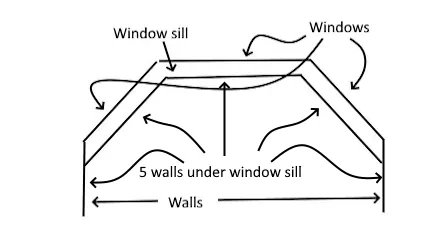
With a true five-sided bay, the shape around the windows normally continues down below the window sill.
The walls underneath the sill follow the same five-sided arrangement. These bays are particularly common in Victorian and Edwardian properties.
You can have either shorter curtains finishing at sill level or longer curtains hanging towards the floor.
However, the depth of the window sills makes an important difference.
If Your True 5 Sided Bay Has Shallow Window Sills
With shallow sills, the track can normally follow the five sides within the bay.
You can choose sill-length or floor-length curtains, provided the track is positioned far enough forward for the fabric to clear the window sills.
If you’d like your curtains to stay entirely within the bay, have a look at my Angled 5 Sided Bay Window guide .
If Your True 5 Sided Bay Has Deep Window Sills
If you’re hanging shorter curtains that finish at window sill level, the track can normally stay within the five-sided bay.
For floor-length curtains, the arrangement is different.
The track needs to be positioned in front of the deep window sills so the curtains can hang freely towards the floor.
It should then continue outside the bay with returns onto the room walls.
This allows the curtains to cover the ends of the window sills that project towards the room, rather than leaving them exposed at either side.
My Angled 5 Sided Bay Window with Returns guide shows how this arrangement works and where to measure to get a price.
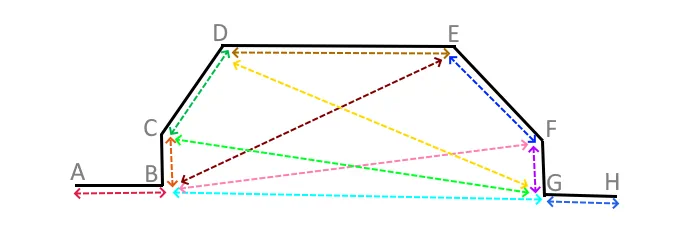
2. The 1930s Bay That Looks 5 Sided
This is where customers can understandably become confused.
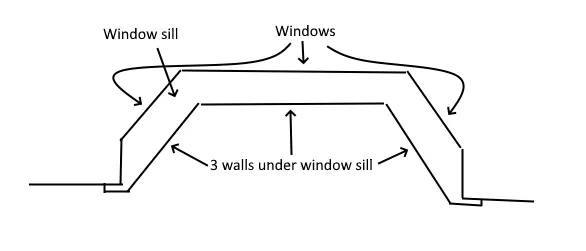
Many 1930s bay windows have three windows and two narrow wall sections above the window sill, making them look like true five-sided bays.
But below the sill, the bay changes to three main walls: a centre wall and two sloping side walls.
That means the best track arrangement depends on whether you’re hanging short or floor-length curtains.
If You Want Curtains Finishing at the Window Sill
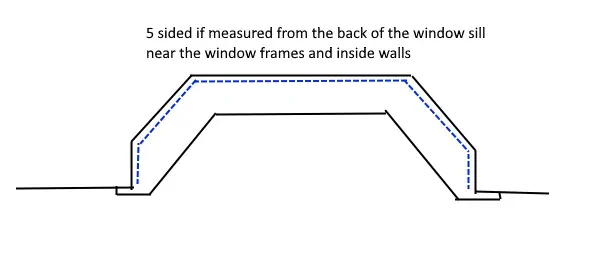
If your curtains will finish around the top of the window sill, you can normally treat this type of window as a five-sided bay.
The curtain track can follow all five sections above the sill, including the two narrow wall sections at the sides.
This also gives the curtains somewhere to stack when they’re open, keeping more of the windows clear.
The important point is that shorter curtains don’t need to hang past the different wall shape below the sill.
If You Want Floor-Length Curtains
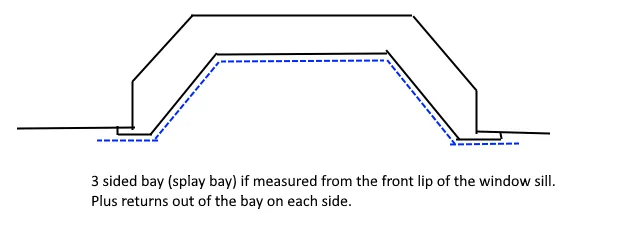
For longer curtains, the track normally needs to follow the three-sided shape below the window sill instead.
I call this arrangement a splay bay with returns.
The track follows the front edge of the window sill across the three main sections and then turns out of the bay onto the room walls.
This allows the curtains to hang freely towards the floor without catching on the sill.
The returns also help cover the ends of the sill and allow the open curtains to stack outside the bay, rather than bunching up in front of the windows.
If this matches your window and you’re planning longer curtains, my Splay Bay Window with Returns guide shows the arrangement you need, including where to measure to get a price.
Don’t Worry Too Much About What Your Bay Is Called
Bay window terminology can make things sound more complicated than they really are.
The important thing isn’t whether your window is technically called a five-sided bay or a 1930s splay bay.
It’s choosing a track that follows the right part of your window and allows your curtains to hang properly.
That’s why I’ve included the diagrams and links to the individual curtain arrangement guides above.
Which Curtain Track Would I Recommend?
For most five-sided bay windows with standard hand-drawn curtains, I’d recommend my Regular Bay Window Curtain Track.
It’s a reliable, good-quality track that can be shaped to follow a true five-sided bay or the splay bay with returns arrangement used for many 1930s windows.
It works smoothly around the bends, is suitable for most domestic curtain weights and is also my lowest-priced bay curtain track.
Are There Other Curtain Track Options?
The Regular Bay Track is my usual recommendation, but there are other options if you need something different.
For a narrower, more discreet track, have a look at my Slimline Bay Track .
If you’re planning to hang wave curtains, you’ll need one of my Wave Bay Window Curtain Tracks .
And if you’d prefer to open and close your curtains using a control cord, you can consider my Corded Bay Window Curtain Track .
Made to Fit Your Individual Bay Window
Every bay is slightly different, so I’ll make your curtain track to match the measurements and angles of your individual window.
All the bends are formed in the correct positions before the track leaves my workshop. It arrives ready to fit, without you having to shape it yourself.
And because I don’t charge extra for bends, the price is based on the overall track length.
Ordering Is Easier Than You Might Think
You only need the overall track length to get a price and place your order.
After ordering, you’ll be guided through providing the detailed bay measurements and photos I need to make your track.
I’ll check everything before manufacturing begins. If something doesn’t look right, I’ll contact you so we can sort it out.
Your finished track comes with my 10-year guarantee and Perfect Fit Guarantee. If it doesn’t fit because of an incorrect measurement, I’ll remake it free of charge.
Still Not Sure Which Bay Shape You Have?
If you’re looking at your window and still aren’t sure whether it’s a true five-sided bay or the 1930s version, you’re welcome to ask me.
Tell me whether you’re planning shorter or floor-length curtains, and include a photo of your bay if you can.
I’ll help you work out which curtain arrangement is likely to suit your window and point you towards the correct guide.