Why Do Curtains Stick Around Bay Window Corners?
Do your curtains glide along the straight parts of your bay window track, then suddenly stop when they reach a corner?
It’s a frustrating problem, especially when you have to pull the curtains around each bend by hand every time you open or close them.
I’ll explain what usually causes it, a few things you can check yourself, and how the right bay window curtain track can make a real difference.
Why Do Curtains Get Stuck at the Corners?
The most common reason is that something is creating resistance as the curtain gliders travel around the bends.
The bend may be too tight, the track may be twisting slightly under the weight of the curtains, or the brackets may not be supporting it properly.
Sometimes the problem is much simpler, such as a damaged glider or a loose bracket.
Before deciding you need a replacement track, there are a few things worth checking.
Six Things to Check if Your Curtains Are Sticking
If you already have a bay window curtain track fitted, these checks may help you understand what’s causing the problem.
- Look at the bends. Are they smooth and rounded, or does the track have a sharp kink where the curtains stop?
- Check whether the track moves. Does it twist, flex or pull away slightly when you operate the curtains?
- Look at the brackets. Are they secure, particularly close to either side of the bends?
- Check the gliders. Are any damaged, twisted or catching inside the track?
- Try moving the gliders without the curtains. If they still catch at the same bend, the problem may be with the track or gliders rather than the curtain weight.
- Consider the curtain weight. Are you using heavy lined or blackout curtains on a lightweight track?
Sometimes a loose bracket or damaged glider can be put right without replacing the track.
But if the bends are badly formed or the track isn’t strong enough for the curtains, a replacement may be the more reliable long-term answer.
1. The Bends Are Too Tight or Too Sharp
This is one of the most common reasons curtains struggle to move around a bay window.
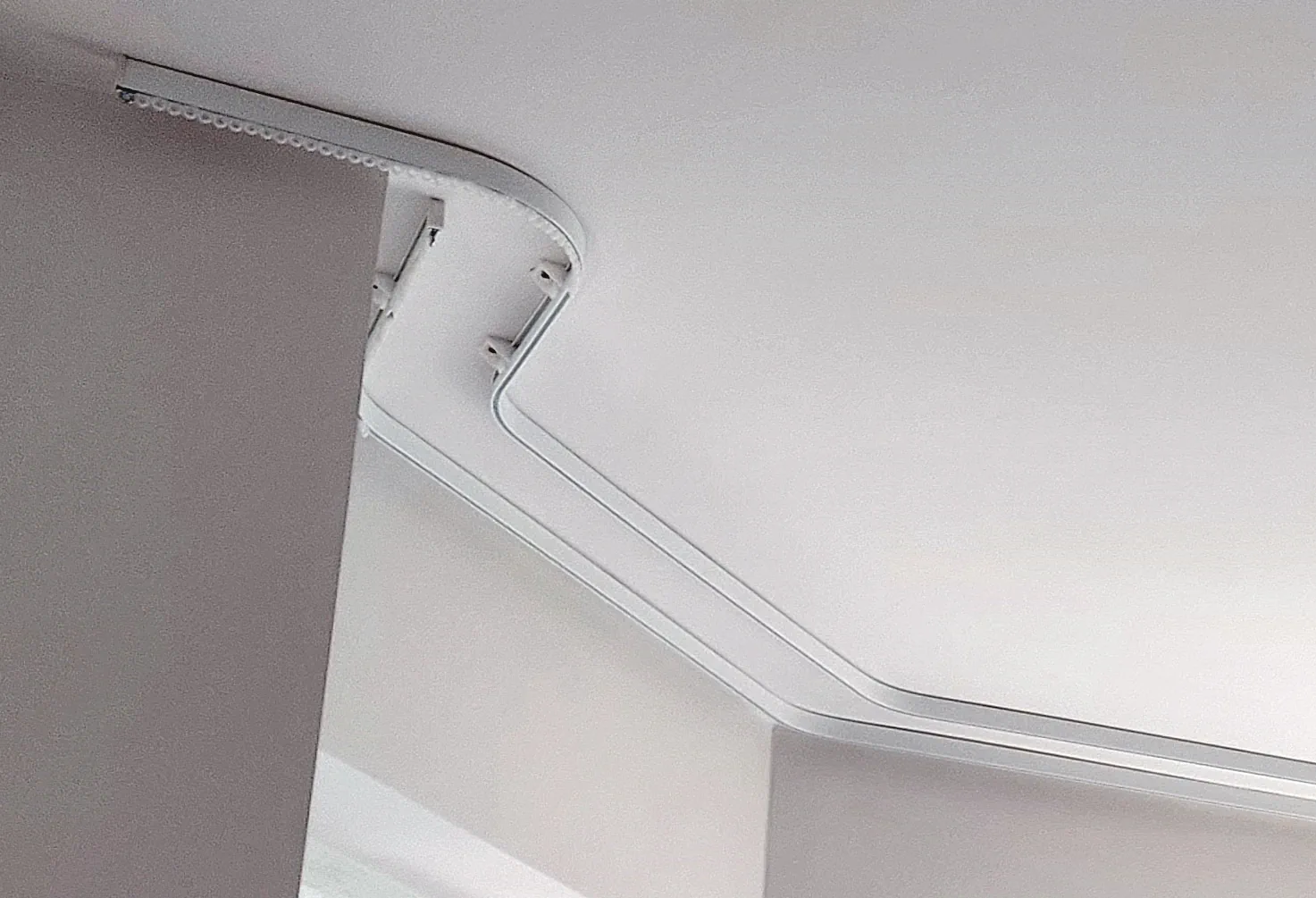
When a track is bent too tightly, the gliders have to negotiate a much sharper change of direction.
Instead of travelling smoothly around the corner, they meet resistance. The leading edge of the curtain may move a little, while the remaining fabric bunches up before the bend.
This can happen with DIY aluminium and plastic tracks, particularly when someone tries to bend the track as closely as possible around the bay.
On our custom-made bay tracks, we generally use a bend radius of around 10cm. This gives a good balance between following the shape of the bay neatly and allowing the curtains to glide around the bends.
2. The Track Is Twisting or Isn’t Properly Supported
Another common problem is the track moving slightly when you pull the curtains.
Some flexible plastic tracks have gliders that wrap around the outside of the track rather than running inside an enclosed channel.
Because the gliders need clearance above the track, these systems cannot always sit directly against the ceiling.
With heavier curtains, the track may flex or twist slightly, particularly around the bends. That movement can cause the gliders to drag rather than glide.
Bracket Positions Matter
A bay window track needs good support around its bends. Ideally, there should be a bracket close to either side of each bend.
If the brackets are too far apart or poorly positioned, the track may flex under load.
We position the brackets on our ceiling-fitted bay tracks to provide even support around the window, particularly near the bends.
3. The Track Isn’t Suitable for Your Curtains
Not every curtain track is designed to carry the same weight or operate in the same way.
Lightweight curtains may move reasonably well on a flexible plastic track, even if the track isn’t particularly rigid.
But full-length lined or blackout curtains place more weight on the track and gliders. This can expose problems with weak profiles, tight bends or insufficient brackets.
Some heavier-duty plastic tracks have the opposite problem. They’re stronger, but the thicker profile may only allow wide, sweeping curves rather than the more defined bends needed for an angled bay.
The important thing is choosing a track that suits both your bay window and the curtains you want to hang.
4. Your Plastic Curtain Track May Be Worn Out
If your plastic curtain track has been fitted for several years, the problem may simply be wear and tear.
This is particularly common around bay window bends, where the gliders repeatedly rub against the same sections of track.
Over time, the smooth plastic running surface can become rough. You may even notice faint lines or grooves scored into the plastic where the gliders have been travelling.
A Simple Way to Check
With the curtains stationary, carefully run your finger along an accessible part of the track, particularly around the bends.
If the plastic feels rough rather than smooth, or you can feel little grooves in the surface, that could explain why your curtains are becoming harder to open and close.
In my experience, many plastic curtain tracks start showing their age after around five years, particularly when they’re carrying heavier curtains around bay window bends.
Some last considerably longer, but if your plastic track is well over five years old and your curtains are starting to stick, wear is certainly worth investigating.
Once the running surface itself has become badly worn, replacing individual gliders may not solve the problem. A new, properly shaped bay window track can be a much better long-term solution.
The Position of the Bends Matters Too
Even a smooth bend can cause problems if it’s in the wrong position.
When a straight track is bent by hand, a bend may start a little too early, finish slightly too late or sit out of line with the bay window.
This can leave the track following an uneven route around the window, making curtain movement less reliable.
That’s one reason we shape our bay tracks in the workshop using the measurements supplied for each individual window.
How a Properly Shaped Bay Track Helps Curtains Glide
Smooth curtain movement isn’t down to one feature alone. The track shape, bend radius, gliders and supporting brackets all need to work together.
With an Ezecurtains bay window track:
- We form the bends to suit your individual bay.
- We use smooth bends designed for reliable curtain movement.
- We supply suitable gliders and brackets.
- We position the brackets to support the track around the bends.
- We check your measurements before manufacturing.
Your track arrives already shaped and prepared for fitting, so you don’t have to bend it around the window yourself.
For most standard pencil pleat or pinch pleat curtains that you open by hand, my usual recommendation is our Regular Bay Window Curtain Track .
You Don’t Need to Measure Every Bend Before Ordering
If you’re thinking about replacing your existing bay window track, you can get a price without taking all the detailed bay measurements first.
You only need the overall track length to get a price and place your order, along with photographs of your bay window.
Afterwards, we’ll guide you through the detailed measurements using the instructions and printable templates for your particular bay shape.
We check those measurements before making your new track, and our Perfect Fit Guarantee provides extra reassurance.
Ready for Curtains That Glide Around Your Bay?
If your existing track is causing problems and you’re considering a replacement, the Curtain Track Finder can help you choose a suitable option from the tracks we supply.
Or, if you’re unsure which track arrangement would work best in your bay, send me a couple of photographs and I’ll help you decide.