

Best Curtain Heading for a Bay Window
A simple guide to the curtain headings that work best with bay window curtain tracks, including pencil pleat, pinch pleat, and wave curtains.
One question I’m often asked is what kind of curtains can be hung from a bay window curtain track.
The good news is that most traditional curtain headings work well, but some are more flexible than others.
The curtain heading affects how the curtains glide, how much space they need when open, and whether they work properly around the bends of a bay window.

Quick Answer
Pencil pleat curtains are usually the most common and flexible choice for bay window curtain tracks.
Pinch pleat curtains give a more tailored look, but they need more accurate sizing and usually cost more to make.
Wave curtains can work beautifully in bay windows, but they need the correct track system and spacing.
Eyelet curtains are generally not suitable for curved bay window curtain tracks because they are designed to hang from poles.
Why Curtain Heading Matters More in a Bay Window
On a straight window, curtain heading is mostly about appearance. In a bay window, it also affects how the curtains move around bends and how neatly they stack when open.
Bay window curtains need to travel around corners, return sections, and sometimes tight angles. This means the heading needs to work properly with curtain track gliders.
The heading style can also affect how much of the side windows are covered when the curtains are open, especially if the bay has narrow side walls.
So the best heading is not just the one you like the look of. It also needs to suit the track, the bay shape, and how much curtain stack space you have.
Pencil Pleat Curtains
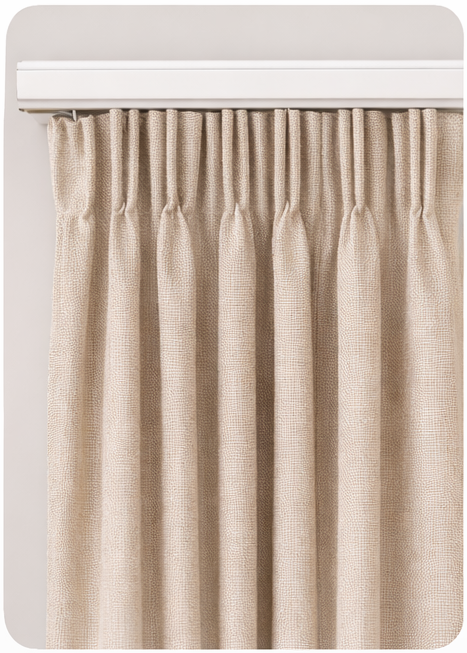
Pencil pleat curtains are by far the most common heading style customers choose for bay window tracks.
There are a few good reasons for this. Pencil pleat curtains are widely available, usually more affordable, and very flexible width-wise.
Most ready-made and many made-to-measure pencil pleat curtains are based on around double the track width in fabric. This gives a full look while still allowing some adjustment when the heading tape is gathered.
That flexibility makes pencil pleat curtains very forgiving. They can usually be adjusted slightly to suit the track width, which is helpful in bay windows where the total track shape and return lengths can vary.
For most customers wanting a simple, reliable curtain heading for a bay track, pencil pleat is often the easiest place to start.
Pinch Pleat Curtains
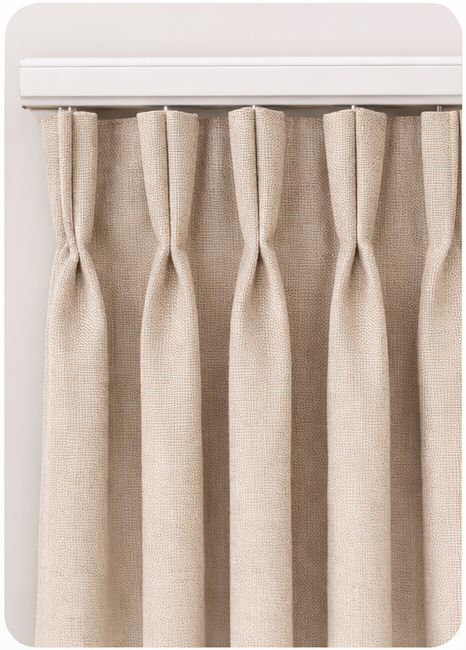
Pinch pleat curtains give a more tailored and structured finish. They are usually custom made and can be made as double pleat or triple pleat curtains.
They generally cost more than pencil pleat curtains because the heading is more involved and needs to be made more accurately.
Pinch pleat curtains are normally made to fit the exact track they will hang from. Unlike pencil pleat curtains, there is very little adjustment once the curtains are made.
Curtain makers will usually work to a specific fullness, often around 2¼ times the track width, depending on the fabric, heading style, and finished look required.
What Is Spring Back on Pinch Pleat Curtains?
With pinch pleat curtains, good curtain makers allow for something often called spring back.
When pinch pleat curtains are dressed and hung properly, the spaces between the sewn-in pleats do not usually sit completely flat. They gently curve, which can create a small amount of tension across the curtain width.
If this is not allowed for when the curtains are made, the curtains may slowly creep back open slightly when closed, leaving a small gap in the middle where the two curtains meet.
Most experienced curtain makers understand this and will allow a little extra width so the curtains close properly.
Pinch Pleat Curtains and Stack Space
Pinch pleat curtains can also need more stack space than people expect.
On many traditional curtain tracks, the curtains hang in front of the track rather than directly underneath it. When the curtains are dressed into their pleats, the double or triple pleats face forward and the spaces between the pleats can pull forward too.
This can make the curtain stack slightly larger, which matters in a bay window because the curtains need somewhere to sit when open.
The exception is when the curtains are hung from a modern track system where the curtains hang underneath the track. In that setup, the spaces between the pleats can fold back more neatly, often allowing the curtains to stack into a smaller space.
Wave Curtains
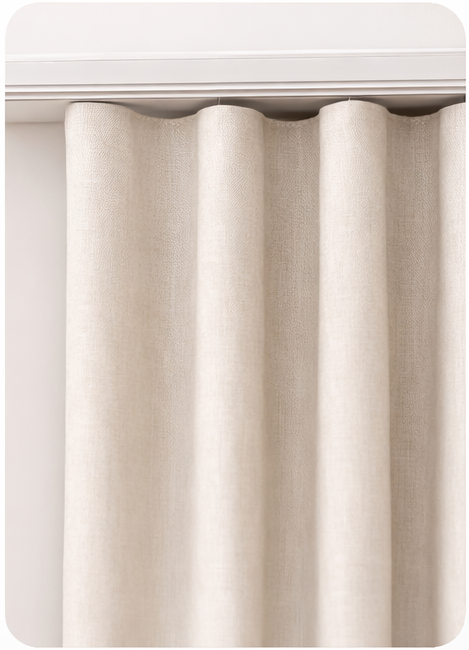
Wave curtains can look very clean and modern in a bay window, but they need the correct track system.
Unlike pencil pleat or pinch pleat curtains, wave curtains rely on special gliders or carriers that are spaced at set intervals. This controls the soft, even wave effect.
Because wave curtains work as part of a track system, they need to be planned properly before ordering the curtains or track.
Wave curtains can be a great option for modern bay windows, but they deserve a separate guide because the track, gliders, spacing, and curtain making all need to work together.
Why Eyelet Curtains Usually Don’t Work on Bay Window Tracks
Eyelet curtains are designed to slide along a curtain pole, not a curtain track.
Because the curtain fabric has large metal rings built into the heading, eyelet curtains cannot be clipped onto standard curtain track gliders.
They also do not work well around curved or angled bay windows, because the rings cannot travel smoothly around the bends in the same way as curtain track gliders.
If you are using a proper bay window curtain track, pencil pleat, pinch pleat, or wave curtains are usually much better options.
Which Curtain Heading Glides Best?
The smoothness of the curtains depends on both the heading and the track system.
Pencil pleat curtains usually glide well on a good quality curtain track, especially when the curtains are not too heavy and the heading is not over-gathered.
Pinch pleat curtains can also glide very well because the heading is more controlled and the curtain hooks are spaced more evenly.
Wave curtains can glide beautifully when they are used with the correct wave track system and carriers.
Which Curtain Heading Stacks Back Best?
If you want to keep as much glass clear as possible when the curtains are open, stack back matters.
Pencil pleat curtains are flexible, but they can create a fuller, bulkier stack if the fabric is heavy or the heading is gathered tightly.
Pinch pleat curtains usually stack in a more organised way, but they still need enough space, especially on traditional tracks where the curtains sit in front of the track.
Wave curtains often create one of the neatest and most controlled stacks, but only when the correct track and wave spacing are used.
Lee’s Advice
For most customers, pencil pleat curtains are the easiest and most flexible choice for a bay window curtain track.
If you want a more tailored look and are having curtains custom made, pinch pleat curtains can look excellent, but the curtain maker needs the exact track width and should allow properly for spring back.
If you want a modern, clean look, wave curtains are worth considering, but they need the correct track system rather than a standard curtain track setup.
I would generally avoid eyelet curtains for bay window tracks. They are really designed for curtain poles, not curved bay tracks.
Still Not Sure Which Curtain Heading to Choose?
If you already have curtains, the first thing to check is whether they can be hung from standard curtain track gliders.
If you are buying new curtains, pencil pleat is usually the simplest and most flexible choice. Pinch pleat and wave curtains can both work well too, but they need a little more planning.
Frequently asked questions
For most bay windows, pencil pleat curtains are the most flexible and straightforward option.
Pinch pleat curtains can give a more tailored look, and wave curtains can look very modern, but both need more careful planning than pencil pleat curtains.
Yes. Pencil pleat curtains work very well on most bay window curtain tracks.
They are widely available, flexible in width, and usually easy to hang from standard curtain track gliders.
Yes, pinch pleat curtains can work very well on bay window tracks.
They need to be made to the correct track width, and the curtain maker should allow for spring back so the curtains close properly without leaving a gap in the middle.
Yes, wave curtains can work beautifully in bay windows, but they need the correct wave track system and spaced carriers.
Wave curtains are not simply hung on a standard track in the same way as pencil pleat curtains, so they need to be planned as a complete system.
No, not on a standard bay window curtain track.
Eyelet curtains are designed for curtain poles. The metal rings in the curtain heading cannot be attached to standard curtain track gliders and do not travel well around bay window bends.
Wave curtains often create one of the neatest and most controlled stacks when used with the correct wave track system.
Pinch pleat curtains can also stack neatly, while pencil pleat curtains may create a fuller stack depending on the fabric and how tightly the heading is gathered.
Helpful Guides to Read Next
These guides will help if you are still planning how your bay window curtains and track should work together.

Should Bay Window Curtains Be Sill Length or Floor Length?
Compare sill-length, just-below-sill, and floor-length curtains for bay windows, including radiator and sill advice.
Should Bay Window Curtains Touch the Floor?
A practical guide to floor-length bay window curtains, including deep sills, uneven floors, and track position.

Should Curtains Sit Inside or Outside a Bay Window?
Not sure whether your curtains should stay inside the bay or return onto the walls? This guide explains what works best for different bay shapes and room layouts.