Why Do Curtains Stick Around Bay Window Corners?
Tight bends, poor support and unsuitable tracks are some of the most common reasons curtains struggle to move around bay windows.
If you have ever tried to pull curtains around a bay window and found they stop at the corner, bunch up, or need teasing around bit by bit, you are not alone.
Bay windows are naturally more demanding than straight windows because the curtains have to move around bends, angles or curves.
This guide explains why curtains can stick around bay window corners, what usually causes the problem, and why the right track shape and support make such a big difference.
The quick answer
Curtains usually stick around bay window corners because the track bend is too tight, too sharp, poorly supported, slightly twisted, or not shaped accurately enough for the bay.
The track may still be fitted and technically working, but the curtains do not glide smoothly because the gliders meet too much resistance around the bend.
This is especially common with DIY bendable tracks, cheaper plastic tracks, and tracks that have been forced into a bay shape during fitting.
What actually happens when curtains stick?
The usual problem is very easy to recognise.
You pull the curtain towards the corner of the bay, it reaches the bend, and then it suddenly stops.
Instead of flowing smoothly around the track, the curtain starts to bunch up before the bend. The leading edge may move slightly, but the rest of the curtain refuses to follow.
The only way to get it around the corner is to tease the curtain from the leading edge, bit by bit, until all the fabric has passed the bend.
That might be manageable once or twice, but it quickly becomes frustrating if you are opening and closing the curtains every day.
Tight bends are one of the biggest causes
One of the most common reasons curtains stick around bay window corners is that the track has been bent too tightly.
This can happen with both aluminium and plastic DIY tracks, especially when someone tries to make the track follow the bay very closely.
If the bend is too tight, the gliders struggle to travel around it. Instead of moving freely, they meet resistance and the curtain starts to bunch before the corner.
Another problem is when the bend loses its smooth radius and becomes more like a sharp angle. This makes the curtain movement even worse.
On our custom-made bay tracks, a bend radius of around 10cm gives a good balance between a neat-fitting bay track and curtains that still move freely around the bends.
Some tracks bend too widely to follow the bay neatly
The opposite problem can also happen.
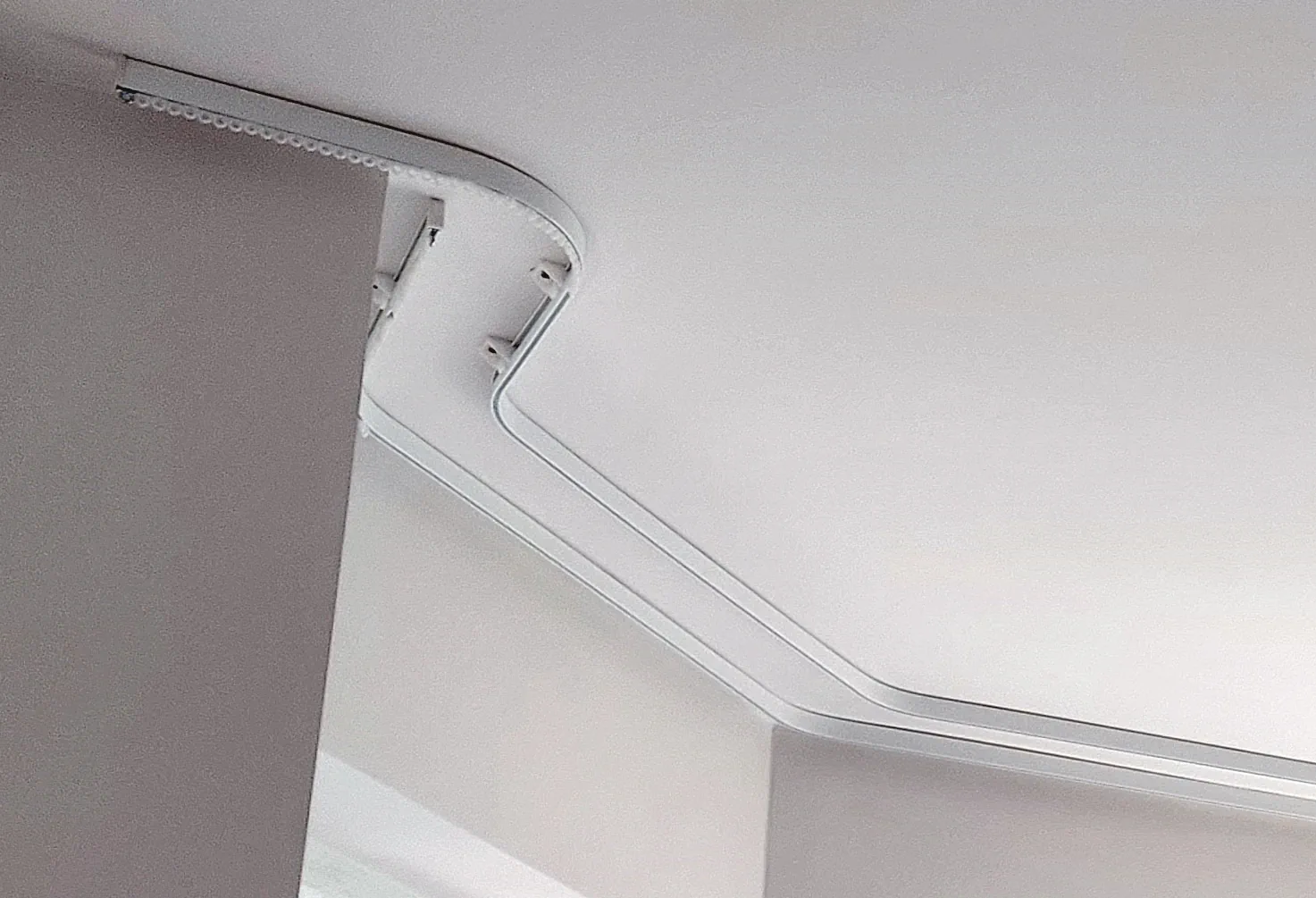
Some heavier-duty plastic tracks can bend, but only in wide sweeping arcs rather than neat, defined bay window bends.
These tracks often have two channels on the back. One channel is used for the brackets to connect to the track, and the other channel is used for the gliders to slide through.
This makes the track stronger than cheaper flat plastic options, but it also makes the profile thicker and harder to bend tightly.
The result is often a track that sort of follows the bay shape, but not as neatly as many customers would like.
This may not always stop the curtains from moving, but it can affect the overall look and make the track feel like a compromise rather than a proper fit.
Plastic tracks can twist under curtain weight
Another cause of resistance is the track twisting slightly, especially around the bends.
This can be more noticeable with heavier curtains on plastic tracks.
With some cheaper flat plastic bendable tracks, there is no proper enclosed glider channel. Instead, the gliders wrap around the top and bottom of the track.
Because the gliders need to run over the top of the track, the track cannot sit flush to the ceiling. It has to be fitted with a small gap between the ceiling and the top of the track.
That gap gives the track more room to move or twist slightly under the weight of the curtains.
Once the track starts twisting, the gliders can drag rather than glide, making the curtains harder to pull around the bay.
Heavy curtains expose track problems faster
Many people worry that their curtains are too heavy for a bay window track. In most cases, the issue is not simply the weight of the curtains.
The bigger issue is whether the track, brackets and bends are suitable for the curtains being used.
Lightweight curtains may hide small problems because there is less weight pulling on the track and gliders.
Full-length lined or blackout curtains are less forgiving. They put more load on the track, so any tight bends, poor support or twisting can become much more obvious.
Bracket spacing makes a big difference
Bay window tracks need more support than straight tracks, especially around the bends.
Ideally, there should be support close to each side of a bend. This helps the track hold its shape and reduces movement when the curtains are pulled.
If there are not enough brackets, or if the brackets are too far away from the bends, the track can flex or twist slightly.
That extra movement creates more friction, which makes the curtains harder to operate.
We supply our ceiling-fitted bay window tracks with brackets positioned around the bay to give strong, even support, especially where it matters most.
The bend position matters too
Even if the bend itself is smooth, it still needs to be in the right place.
With DIY bendable tracks, it is very easy for the bend to start slightly too early, finish slightly too late, or sit slightly out of line with the true bay shape.
When that happens, the track may not follow the bay neatly. The curtain then has to travel around a bend that does not properly match the window shape.
Small inaccuracies can make a noticeable difference in a bay window because the curtain is being pulled through several changing angles instead of along one straight line.
Why pre-bent bay tracks usually glide more smoothly
A made-to-measure bay window curtain track is shaped before it arrives, so the bends are already formed to suit the measurements you provide.
This removes a lot of the guesswork from the process.
Instead of trying to bend a straight track yourself and hoping the curtains run smoothly afterwards, the track arrives already shaped and ready to fit.
A good bay track needs:
- Smooth bends with a sensible radius
- Support close to each side of the bends
- A track profile strong enough for the curtains
- Gliders designed to move smoothly through the channel
- A shape that follows the bay accurately
When all of those things work together, the curtains have a much better chance of gliding smoothly around the bay.
The simple way to think about it
Curtains usually stick when the track creates resistance.
That resistance can come from a tight bend, a sharp angle, a twisting track, poor support, or a bend that does not quite match the bay.
The smoother and better supported the track is, the easier it is for the curtains to move around the corners.
Simple things that help curtains move better
If you already have a bay window track fitted and the curtains are sticking, there are a few things worth checking.
- Check whether the bend looks smooth or too sharp
- Check whether the track twists when the curtains are pulled
- Check whether the brackets are close enough to the bends
- Check whether the gliders move freely without the curtain attached
- Check whether the curtains are too heavy for the track system
- Check whether any brackets or screws are pulling the track out of line
Sometimes small adjustments can help. But if the track itself is the wrong shape, too weak, or badly supported, replacing it with a better bay window track is often the more reliable solution.
Want curtains that glide smoothly around your bay?
If you are choosing a new track for your bay window, it is worth choosing one that is designed to follow the bay properly from the start.
Our made-to-measure bay tracks arrive pre-bent to shape, with the correct brackets and gliders supplied, so you are not trying to solve these problems during fitting.
Related bay window curtain track guides
This guide is part of our bay window curtain track planning series.