
The Right Way to Fit a Track in a Square Bay Window
Introduction
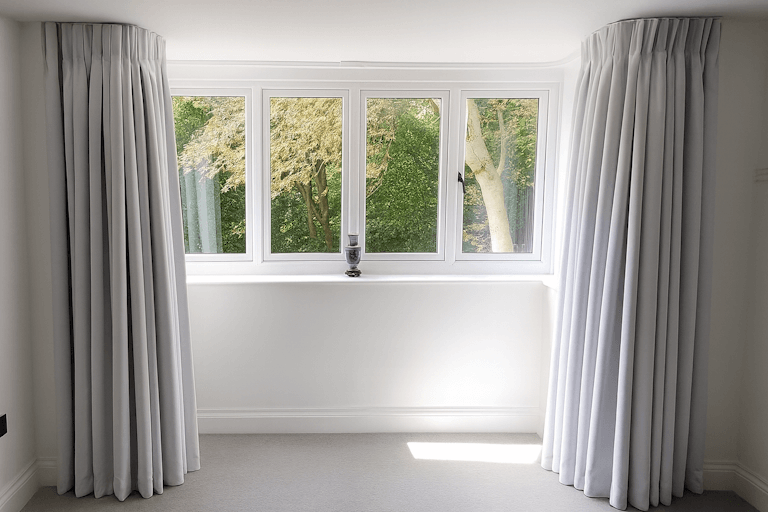
Square bay windows look elegant, but they do raise a few questions when it comes to fitting a curtain track neatly. Should you use battens? Ceiling brackets? Or even fix to the architrave?
Here’s my advice based on 25+ years of fitting bay tracks — plus a step-by-step guide on how to measure your square bay so your new track fits perfectly.
-
10-Year Guarantee
Free remake if it doesn’t fit — even if mis-measured
-
Video Measuring Guides
Short step-by-steps so you know it’s right
-
No Charge Per Bend
You pay for length only — big savings on multi-bend bays
-
Fast UK Delivery
Recyclable, eco-friendly packaging as standard
Flush Fit vs Battens
Kathryn from Bristol asked me whether she should use battens or just fix the track directly to the ceiling. Here’s my answer:
👉 Skip the battens.
I personally don’t like battens fixed to a ceiling. I prefer to fit the track directly to the ceiling — it looks far neater, and you have to fix one or the other anyway.
Our custom-made square bay window tracks are designed to sit flush with the ceiling, giving you a sleek finish when your curtains are open.
Where the Strength Really Matters
It’s natural to worry about ceiling fixings, especially with lined or full-length curtains. But here’s what most people forget:
- End brackets do most of the work.
Around 80% of the weight sits on the last couple of brackets when curtains are open. - Lintels and returns = solid fixings.
- End brackets are often fixed into a lintel above the window (timber or metal).
- If your track returns out of the bay onto side walls, those wall fixings go into brickwork — very strong.
- Intermediate brackets carry less.
When curtains are closed, the weight is spread evenly, so each ceiling bracket only carries a fraction.
👉 That’s why your track will stay secure without battens.
Don’t Rely on Architrave
Kathryn also asked about fixing into plaster architrave. My advice? Only as a last resort.
Architrave is just plaster — not solid enough for a long-term fixing. Brickwork or ceiling fixings are far more reliable.
Track Curves in a Square Bay
Another common question: how are the corners bent?
We bend curves at a 10cm radius. This avoids deforming the track and ensures your curtains glide smoothly around the corners. Any tighter, and the fabric would bunch up.
Measuring a Square Bay Window
How to Measure a Square Bay Window
Introduction
Let me show you how to measure your square bay window for a custom-made curtain track that will fit flush to the ceiling within the bay.
This example is for sill-length curtains, but it works for both single tracks and double tracks. With a double track, both curtains will hang down to meet the sill.
Marking Measuring Points
Start by adding measuring points around your bay window. Use Post-it notes with letters written on them — this makes it simple to measure between each point without losing track.
In the video, you’ll see these measuring point letters appear in red on the bay.
Taking Measurements
Take all your sizes from the back of the windowsill, where it meets the bottom of the window frames. On the side bays, measure across the window frame and the side wall, following the yellow arrows shown in the video.
Measure between each lettered point and record each size in its own box on the final sizes form.
Final Checks
Once you’ve measured all the way around the bay, take these additional sizes:
- Across the bay, wall-to-wall, from point A to D.
- Diagonal A to C.
- Diagonal D to B.
- The sill depth — how much the ends of the sill stick out from the wall underneath. If they don’t project beyond the wall, enter zero in the form.
Need Help?
That’s all there is to measuring a square bay window for a ceiling-fitted curtain track. If you have any questions, just ask — we’re always happy to help.
- Works for single or double tracks, sill length curtains.
- Mark measuring points with Post-it notes (letters A–D).
- Measure from the back of the windowsill where it meets the frames.
- Record each section between lettered points.
- Take wall-to-wall and diagonal measurements (A–D, A–C, D–B).
- Check sill projection depth and record it (or zero if flush).
Video Highlights
- Mark points A–D with Post-its.
- Measure from back of sill.
- Record each section + diagonals.
- Note sill depth if it projects.
Video Highlights
Measuring a Square Bay with Returns
Step-by-Step Video
How to Measure a Square Bay with Returns
Introduction
Let me show you how to measure your bay for a square bay window with returns curtain track. You’ll be taking all your sizes from the front lip of the window sill.
This track will be ceiling fixed within the bay, then wall fixed on the returns if the room ceiling is higher than the bay ceiling. If the bay and room ceiling are the same height, the whole bay window curtain track will be ceiling fixed.
Marking Measuring Points
You will see red letters appear around the bay. These are your measuring points. Measure between each and enter the sizes in the final sizes form.
Tip: use Post-it notes with letters at each measuring point. This makes it easy to remember which point is which.
Measuring the Returns
When measuring the track returns A–B and E–F, measure the sill end plus an additional 20cm of wall. For example, if the sill end is 15cm, the total return width will be 35cm.
Measuring Across the Bay
Next, measure the widths across the measuring points:
- Across the front lip of the windowsill within the bay.
- Across the ends of the sill on the returns (include 20cm wall depth).
Diagonal and Sill Measurements
Now measure:
- Across the mouth of the bay (points B–E).
- The diagonal sizes (points B–D and E–C).
- The sill depth if the sill projects beyond the wall. Enter this in the “return sill depth” box on the form.
Finishing Up
That’s all there is to measuring a bay window for a square bay with returns curtain track. The track will be ceiling fixed within the bay, and either wall or ceiling fixed on the returns depending on your ceiling height.
Need More Help?
If you need any extra help:
- Use the Help Assistant button in the bottom corner of your screen.
- Or, contact us via the website form or by phone.
How to Measure a Square Bay Window
Introduction
Let me show you how to measure your square bay window for a custom-made curtain track that will fit flush to the ceiling within the bay.
This example is for sill-length curtains, but it works for both single tracks and double tracks. With a double track, both curtains will hang down to meet the sill.
Marking Measuring Points
Start by adding measuring points around your bay window. Use Post-it notes with letters written on them — this makes it simple to measure between each point without losing track.
In the video, you’ll see these measuring point letters appear in red on the bay.
Taking Measurements
Take all your sizes from the back of the windowsill, where it meets the bottom of the window frames. On the side bays, measure across the window frame and the side wall, following the yellow arrows shown in the video.
Measure between each lettered point and record each size in its own box on the final sizes form.
Final Checks
Once you’ve measured all the way around the bay, take these additional sizes:
- Across the bay, wall-to-wall, from point A to D.
- Diagonal A to C.
- Diagonal D to B.
- The sill depth — how much the ends of the sill stick out from the wall underneath. If they don’t project beyond the wall, enter zero in the form.
Need Help?
That’s all there is to measuring a square bay window for a ceiling-fitted curtain track. If you have any questions, just ask — we’re always happy to help.
Video Highlights
- Works for single or double tracks, sill length curtains.
- Mark measuring points with Post-it notes (letters A–D).
- Measure from the back of the windowsill where it meets the frames.
- Record each section between lettered points.
- Take wall-to-wall and diagonal measurements (A–D, A–C, D–B).
- Check sill projection depth and record it (or zero if flush).
Video Highlights
- Mark points A–D with Post-its.
- Measure from back of sill.
- Record each section + diagonals.
- Note sill depth if it projects.
- Take all sizes from the front lip of the windowsill.
- Mark measuring points A–F with Post-it notes for easy reference.
- Measure between each point and enter into the final sizes form.
- For returns (A–B and E–F), add 20cm of wall to the sill depth.
- Measure across the bay mouth (B–E) and diagonals (B–D, E–C).
- Check if the sill projects beyond the wall and enter that size in the “return sill depth” box.
- Track will be ceiling fixed in the bay, then wall or ceiling fixed on returns depending on ceiling height.
Video Highlights
- Measure from front lip of sill.
- Mark A–F points with Post-its.
- Add 20cm wall to returns.
- Record bay mouth, diagonals, and sill depth.
Video Highlights
Curtain Style Choices
Kathryn also asked about headings:
- French pleats can be fitted to sit very close to the ceiling.
- Wave style curtains hang just under the track, but still look sleek with a flush-fit ceiling track.
Both work beautifully in a square bay.
Next steps – Right Way to fit a Curtain track in a Square Bay Window
If you’re planning a new track for your square bay:
- Our [Regular Bay Window Curtain Track] and [Slimline Bay Window Curtain Track] are both ideal.
- For a sleeker modern look, consider our [Modern Bay Track with Wave Gliders].
👉 Haven’t ordered yet? Browse all our [Bay Window Curtain Tracks] or [Get in Touch] for personal advice.