How to Measure a Five-Sided Bay Window for Floor Length Curtains
If you’ve got a five-sided bay window with a shallow window sill or no sill at all, this guide shows you how to measure for a ceiling-fixed curtain track designed for full-length curtains.
We’ll still do the main measuring at sill level (or where the wall meets the frames if there’s no sill), because it makes everything much easier and more accurate. Your track will then be ceiling-fixed inside the bay so the curtains can fall cleanly all the way down to the floor.
When this guide is right for your window
Use this guide if:
- Your bay has five sections (three across the front and two angled sides).
- You have a shallow sill or no sill at all.
- You’d like full-length curtains that fall to the floor.
- You’re planning a ceiling-fixed track inside the bay.
- You’re happy for the curtains to stack inside the bay on the short side walls when they’re open.
This page is for ceiling fixing only. If you need a wall-fixed solution for a five-sided bay, I’ll be writing a separate guide so there’s no confusion between the two.
If you’re dealing with a deep sill and sill-length curtains instead, use the matching guide for that setup: How to measure a five-sided bay window for sill-length curtains.
Step-by-step: how to measure your five-sided bay for long curtains
Step 1 — Mark your measuring points (A to F)
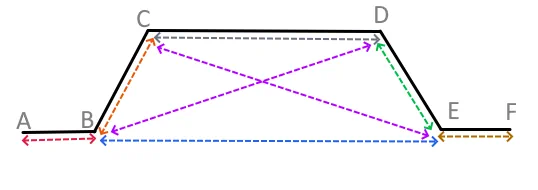
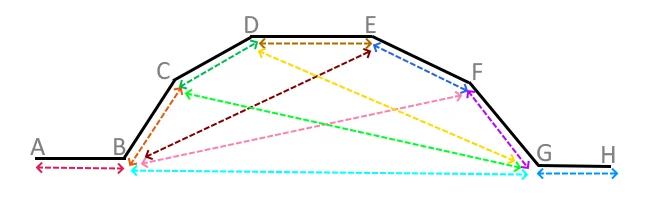
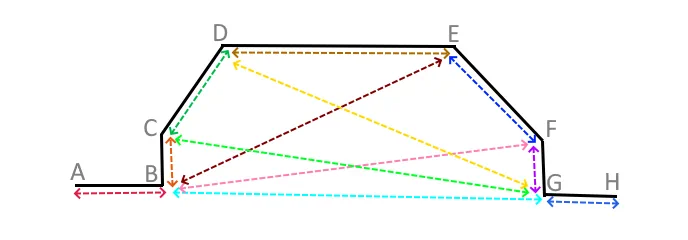
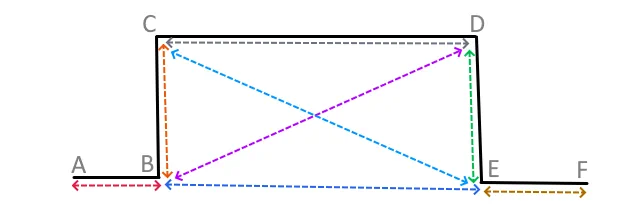
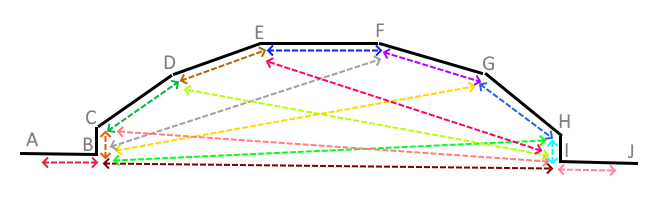
Just like with the sill-length version, we’ll start by labelling key points around the bay. Use small Post-it notes or masking tape and mark:
A – B – C – D – E – F

These follow the shape of the bay:
- A and F – the short side walls at each end of the bay.
- B, C, D – the three main front sections of the bay.
- E – the other angled side returning towards the room.
All your measurements will be taken from point to point along the back of the sill, where it meets the window frames. If there is no sill, measure from the line where the wall meets the window frames instead.
Step 2 — Measure each section at sill level
Even though your curtains will be full length, measuring at sill level keeps everything simple and consistent. The shape of the bay doesn’t change as you move up towards the ceiling — and we’ll check everything using diagonals.
Measure:
- A → B
- B → C
- C → D
- D → E
- E → F
Measure along the back of the sill (or the wall/frame junction if there’s no sill), following each angle naturally. These sizes show us the exact shape of the bay at sill level.

Step 3 — Measure straight across the bay (A to F)
Next, measure straight across the back of the bay from A → F. This gives us the overall wall-to-wall width and helps confirm your section measurements when we draw your bay out full-size on the workbench.
Step 4 — Measure the diagonals
Diagonal measurements help us check that everything lines up and catch any numbers that don’t quite add up. They’re especially useful when we’re using sill-level measurements for a ceiling-fixed track.
Measure:
- A → D
- A → E
- F → B
- F → C
Think of this as your built-in “sanity check”. If any measurement is significantly out, it will be very obvious when we plot your bay and compare it with your photos.
Step 5 — Check the wall above the windows
Finally, take a quick look at the wall between the top of your window frames and the ceiling. In some bays, the plaster above the frames can stick out slightly further into the room than the frames themselves.
If the wall above the windows projects further into the room than the face of the window frames, please tell us by how much. You can pop this into the “Additional Info” box on the final sizes form.
A simple note like “Wall above frames sticks out approx. 5cm more than window frames” is perfect. This helps us allow for that overhang when we bend the track so everything sits neatly when it’s ceiling-fixed.
How your long curtains will hang and stack
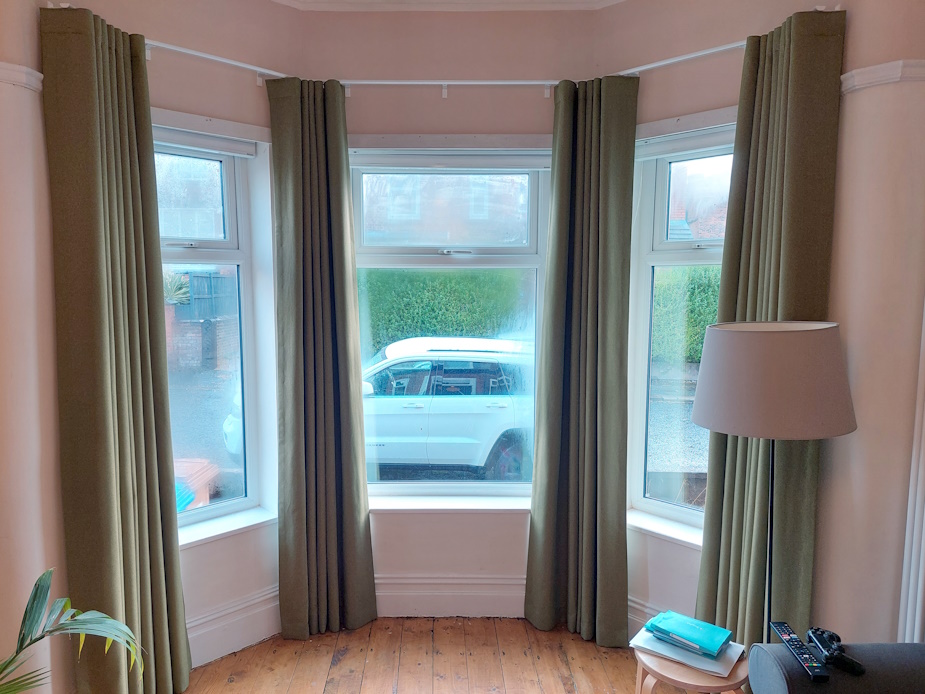
With a shallow sill or no sill at all, a ceiling-fixed track lets your curtains fall straight down to the floor without clashing with the sill.
Your full-length curtains will:
- Hang close to the line of the glass, following the shape of the bay.
- Fall cleanly down to the floor with no “kink” over a deep sill.
- Stack back inside the bay, mainly onto the short side walls at A–B and E–F.
Depending on how wide those side walls are and how thick your fabric is, the stacked curtains may cover some of the side glass when they’re fully open. That’s normal and often a good trade-off for having a neat, full-length look inside the bay.
If you’re unsure how your own curtains will behave, send me a quick photo and tell me roughly what fabric you’re thinking of. I’ll happily give you an honest opinion before you order.
What if I want a wall-fixed track instead?
This guide is for ceiling-fixed tracks only, because that’s usually the neatest and most reliable option for five-sided bays with long curtains.
If your bay has awkward ceilings, coving, or other obstacles that rule out ceiling fixing, I’ll be putting together a separate guide that looks specifically at wall-fixed tracks in five-sided bays. That way, there’s no confusion between the two methods.
In the meantime, if you think you might need a wall-fixed solution, just send me a photo of your bay and a quick note explaining the issue. I’ll tell you honestly what will and won’t work.
Frequently asked questions
Because the sill depth changes everything. With a deep sill, it’s much better to stop your curtains at sill length. With a shallow or non-existent sill, you can safely run the curtains all the way to the floor.
Having separate guides keeps things simple and avoids any confusion about which method to follow.
Measuring at sill level (or where the wall meets the frames if there’s no sill) is easier and more consistent. The shape of the bay stays the same as you go up towards the ceiling, and the diagonal checks confirm that everything adds up.
We then use those sizes to bend a track that follows the true shape of your bay when it’s ceiling-fixed. We will also ask you on the final sizes form for the depth of the window sill, assuming there is one. If not just enter “0”.
That’s absolutely fine. In that case, just measure from the line where the wall meets the bottom of the window frames, rather than from the back of a sill. The process is exactly the same otherwise.
We will also pick this up when viewing your bay photo sent with your order.
If the plaster above the windows sticks out further into the room than the window frames, it can affect how the track sits when it’s ceiling-fixed. Letting us know by how much means we can allow for that overhang when we bend the track, so it all lines up neatly.
A quick note in the “Additional Info” box on the form is all we need.
Yes. With this setup, the curtains are designed to stack inside the bay, mainly onto the short side walls at A–B and E–F. Depending on how wide those walls are and how full your curtains are, they may cover some of the side glass when fully open.
If that’s a concern, mention it when you get in touch and I’ll happily advise on fabric fullness and track position.
Don’t worry, it’s more common than you’d think for bays to have at least one number that doesn’t quite make sense. That’s why we ask for section sizes, straight across and diagonals.
When we draw your bay out full-size and compare it with your photos, any odd sizes usually stand out straight away. If something doesn’t look right, I’ll come back to you before we make anything.
Next Steps
If you’re ready to choose your track, you’ll find the best options just below.
If you’re still unsure, just send me a quick photo of your bay and I’ll point you in the right direction. Nice and simple.