Are My Curtains Too Heavy for a Bay Window Ceiling?
One question I hear quite often is: “My curtains are heavy. Will a ceiling-mounted bay window track really hold them?”
For most domestic curtains, including heavy lined and full-length curtains, the answer is yes — provided the ceiling is sound and the brackets are fixed securely.
Our made-to-measure bay window tracks are designed for domestic use, and we supply plenty of brackets to support them properly.
I’ll explain why the fixing positions matter and when you might need to take extra care.

Will a Ceiling-Mounted Bay Track Hold Heavy Curtains?
In my experience, people often underestimate how well a properly fitted bay window curtain track can support normal domestic curtains.
That includes many lined, blackout and interlined curtains.
The key isn’t simply how strong the track is. It’s how the track is supported and what the brackets are fixed into.
Our tracks are supplied with approximately twice as many ceiling brackets as many other suppliers.
Having more support points helps distribute the weight around the bay instead of leaving it concentrated on a few fixings.
My advice: Don’t assume you need a heavy-duty track simply because your curtains are lined or full length. For most domestic bays, a suitable standard Ezecurtains track, correctly fitted, will do the job.
Why the Bracket Positions Matter
Extra Brackets Spread the Load
When the curtains are drawn around the bay, their weight is supported by several brackets.
Closer bracket spacing also helps prevent the track from dipping between fixing points.
Support Near the Ends of the Bay
When curtains are open, much of the fabric gathers near the ends of the track. Those end fixing positions are therefore particularly important.
Depending on the property, brackets near the ends of the bay may fix into timber or metal lintels above the windows.
If the track returns onto the surrounding walls, some end fixings may be into masonry.
These can provide strong fixing positions where the material is suitable and the correct screws or plugs are used.
But it’s important to check what you’re actually fixing into — not every bay is constructed the same way.
What About Plasterboard Ceilings?
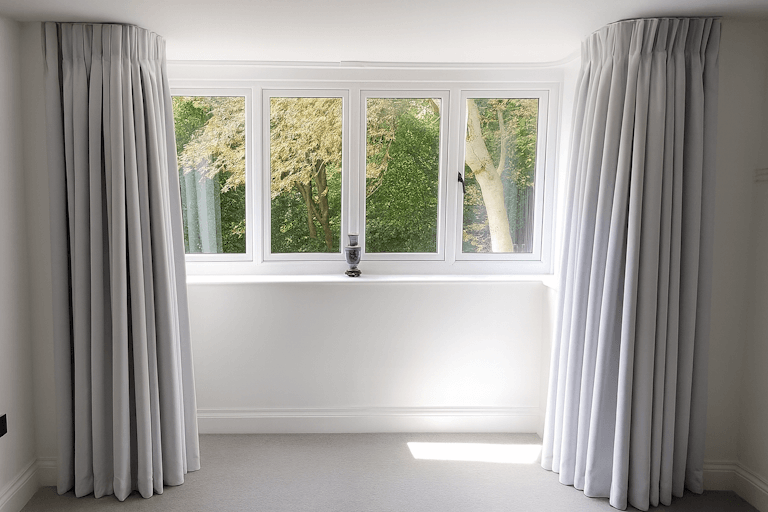
Many domestic bay windows have plasterboard ceilings.
A sound plasterboard ceiling can often support a curtain track with suitable fixings, even where the brackets don’t all line up with timber joists.
There’s no need to go hunting for every joist. The brackets need to follow the shape of your bay, and joists won’t necessarily be in the right positions.
What does matter is that every fixing grips securely and that the ceiling is in good condition.
If a supplied plug doesn’t hold firmly in a particular position, an alternative fixing such as a toggle bolt may be suitable for sound hollow plasterboard.
Read my guide to using toggle bolts →
Important: If the plasterboard is loose, cracked, damp or crumbling, don’t simply add more brackets or bigger fixings. The ceiling itself needs checking before you hang the curtains.
Would Extra Brackets Help With Particularly Heavy Curtains?
We already include plenty of ceiling brackets with our bay tracks.
In some circumstances, such as an unusually long return or a particular curtain arrangement, additional brackets may be worth considering.
But more brackets aren’t automatically the answer. The load, ceiling construction and fixing positions all need to be suitable.
If you’re unsure about a particularly heavy set of curtains, send us a photograph of the window and tell us about the curtains you’re planning to hang.
We can advise on a suitable track from the range we supply.
Watch My Bay Window Ceiling Fixing Video
In this video, I explain how I fit our pre-shaped bay window tracks to different ceiling materials, why you don’t need to find every joist and how to deal with a fixing that doesn’t feel secure.
Read the Video Transcript
How to Fit a Curtain Track to a Bay Window Ceiling
Hi, I’m Lee Stevens from ezecurtains.co.uk. I hear this a lot: “My ceiling isn’t strong enough for a ceiling-fixed curtain track. I need to know where the joists are so I can fix all my brackets into them.”
The truth is, for domestic windows, your ceiling is almost certainly strong enough. I’ve fitted thousands of bay tracks over nearly 30 years, and the joists are rarely in the perfect places for every bracket anyway—so you don’t need to find every single one.
The Big Idea (Don’t Overthink the Joists)
- Most domestic ceilings are hollow (lath & plaster or plasterboard). That’s normal.
- You’ll usually hit some timber with a few screws—great—but it’s not essential for every bracket.
- Start with the supplied screws and plugs; they work for 95–98% of fittings.
- Only reach for alternative fixings if a particular spot isn’t firm enough.
Basic Fitting Approach
- Present the pre-bent track to the ceiling and position it to your marks.
- Drive the supplied screws straight through the bracket holes into the ceiling.
- Note which brackets feel solid (often the end brackets hit a lintel) and which need extra attention.
- If a fixing isn’t firm: slide the bracket aside, drill a pilot/hole as needed, add a suitable plug, slide the bracket back, and re-fix.
Fixing Into Different Materials
Timber lintel (often in older houses): Drive the screws straight in—nice and secure.
Metal lintel (common in newer houses): Use a 3.5 mm high-speed steel (HSS) drill bit to make a pilot hole, then drive the supplied screws directly—no plug needed.
Brick returns (where the track turns out of the bay): Use the supplied red plugs. Drill a 6 mm hole with a masonry bit, insert the plug flush with the surface, and screw the bracket back on.
When to Use Alternative Fixings
Only if the supplied screws/plugs don’t give a firm fixing (that’s rare). Keep a couple of alternative fixings in mind, but don’t buy everything up front—nip to your local DIY store if you actually need them.
What You Don’t Need to Do
- Don’t lift floorboards upstairs hunting for joists.
- Don’t try to move brackets to meet every joist position—your support needs to follow the bay shape, not the joists.
Final Tips
- The last bracket on each side (just before the track turns out of the bay) usually fixes into the lintel—this gives excellent support for stacked curtains.
- For very smooth running, your track is supplied pre-sprayed with silicone. Give it a quick spray annually to keep it gliding.
- These guidelines apply to domestic-size windows and curtains (including heavy blackout); not stage-scale curtains.
In Short
Start with the basics: fit all brackets with the supplied screws and plugs, accept that a few will land in timber (bonus), reinforce any soft spots with a plug or pilot-and-screw into metal lintel where needed, and you’re done—no joist-hunting required.
Frequently Asked Questions
Can I hang heavy lined curtains from a bay window ceiling track?
Yes, in most domestic situations. Our bay window tracks are designed for domestic curtains, including many heavy lined and blackout curtains. The ceiling must be sound and the brackets securely fitted.
Do I need a heavy-duty track for heavy curtains?
Not necessarily. A standard Ezecurtains track is suitable for many domestic curtain arrangements. The curtain weight, track length and bay shape all help determine the best option.
Will the brackets pull out of plasterboard?
Sound plasterboard with suitable, correctly installed fixings can often support domestic curtain tracks. Each bracket must be checked for a secure hold; damaged or weak plasterboard needs attention before fitting.
Would fitting more brackets make the track stronger?
Extra brackets can spread the load across more fixing points, but they cannot make an unsound ceiling safe. We already supply plenty of brackets with our bay window tracks.
Do I need wooden battens for heavy curtains?
Usually not. Our tracks are designed for direct fixing to suitable ceilings. A batten is only helpful if it forms part of a properly secured fixing arrangement.
My Final Recommendation
Don’t let the weight of normal domestic curtains put you off ceiling fixing.
In most cases, one of our made-to-measure bay tracks will be perfectly suitable, provided it’s installed with secure fixings into a sound ceiling.
Our tracks arrive already shaped to your bay, with plenty of brackets and standard fixings supplied.
That makes fitting simpler and helps support the curtains properly around the window.
If you’re planning something unusually heavy or aren’t sure about the ceiling construction, ask before ordering rather than guessing.
More Help With Bay Window Ceiling Fixing
You’ll find more practical advice about ceiling brackets, battens and alternative fixings in our ceiling-fixing guides.