Why Doesn’t My Bay Window Look the Same at Ceiling Height?
Some bay windows have one shape around the window sill and a very different shape at ceiling height. This can make a correctly positioned curtain track look much farther away from the windows than expected.
The important thing is not simply where the track sits against the ceiling. The real question is how your floor-length curtains need to hang around the bay without catching on the window sill, radiators or any other obstacles.
Quick Answer
A bay window curtain track should not be positioned by looking only at the ceiling or the walls above the windows.
The track position is determined by where your curtains need to hang. For floor-length curtains, they normally need to follow the bay shape while hanging in front of the window sill and clearing any other obstacles.
This sometimes means the track must sit much farther away from the window frames than you might expect when looking upwards at the ceiling.
One Bay Window with Two Different Shapes
Many bay windows have walls above the windows that are broadly in line with the walls underneath the window sill. This gives the bay a similar shape from floor level right up to the ceiling.
That is not always the case.
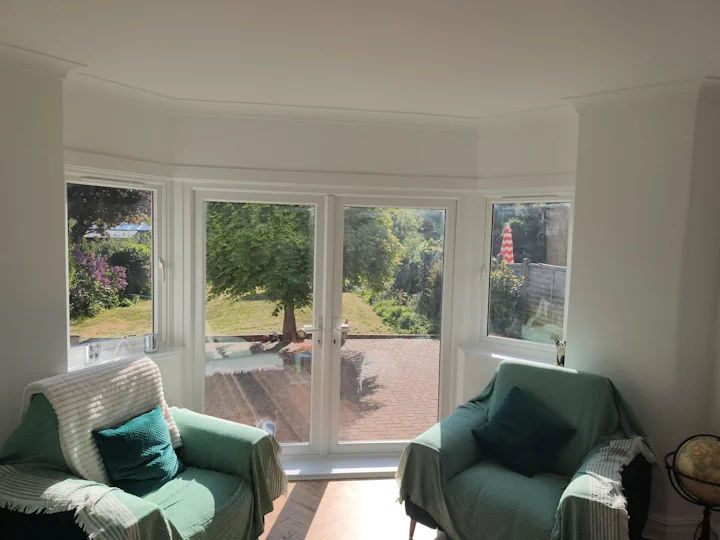
In the bay window shown on this page, the walls underneath the sill are set in line with the main room. The window frames are then recessed approximately 20cm farther back into the bay.
This creates a deep window sill of around 22cm, including a front lip that projects approximately 2cm beyond the walls underneath.
At the top of the windows, the wall is not brought forward to match the walls underneath the sill. Instead, the wall above the windows remains recessed in line with the window frames.
The result is a bay window that appears to have one shape at sill height and a much more deeply recessed shape at ceiling height.
Start with How You Want the Curtains to Hang
When planning a curtain track, it is easy to begin by looking at the ceiling and asking where the track should fit.
However, this does not give you the full picture.
The first question should be:
How do you want your curtains to hang?
If you want floor-length curtains, they need to hang naturally around the bay while clearing the front edge of the window sill.
They may also need to clear radiators, window handles, deep reveals or other obstacles within the bay.
Once the correct curtain line has been established, the curtain track can be positioned directly above it.
The curtains determine the track position. The ceiling does not determine it on its own.
Why Does the Track Sit So Far Forward of the Windows?
In this example, the window frames and walls above the windows are recessed approximately 20cm behind the walls underneath the sill.
The curtains cannot hang close to those recessed window frames because they would meet the deep window sill below.
Instead, the curtains need to hang in front of the sill. This means the track must also pass in front of the sill, even though it is being fitted at ceiling height.
When viewed on its own, the track can therefore appear to sit a long way out from the windows.
This does not mean the track is necessarily in the wrong position. It may be exactly where it needs to be for the finished curtains to hang properly.
How Decorative Coving Makes the Difference Look Bigger
This particular room also has decorative coving around both the main room and the bay window.
On the two side sections of the bay, the track can fit reasonably close to the coving. However, the coving over the three windows is set much farther back because it follows the recessed wall above the window frames.
The curtain track cannot follow this deeply recessed coving line over the windows. It still needs to remain far enough forward for the curtains to clear the window sill below.
In practical terms, the track has to pass over the windows as though the wall and coving continued forward near the front edge of the sill.
This can make the track appear particularly far away from the coving over the windows, even though it sits much closer to the coving on the sides of the bay.
The contrasting coving positions exaggerate the appearance, but the track is still following one continuous and usable curtain line around the bay.
Would the Same Problem Exist Without Coving?
Yes. The same basic issue would still exist even if the room had no decorative coving.
The wall above the windows would remain recessed behind the front edge of the window sill. Floor-length curtains would still need to hang farther forward so they could clear the sill.
The difference would simply be less visually striking.
Coving makes the change in wall position easier to see because it creates a strong decorative line around the ceiling. Without coving, the space between the track and the recessed wall may look less unusual, but the required track position would be much the same.
Understanding the Curtain and Track Position
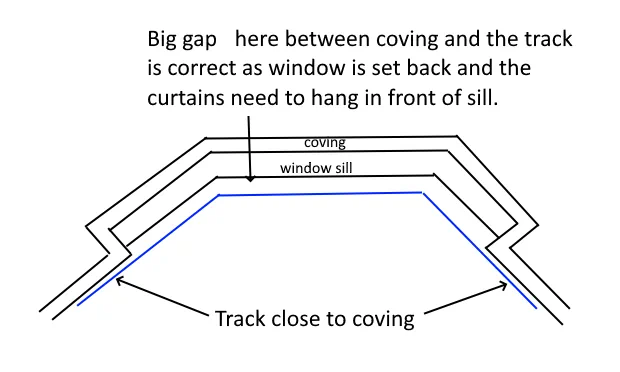
The drawing below shows why looking only at the ceiling can be misleading.
The wall and window frames at ceiling height are recessed into the bay. However, the window sill projects much farther forward below.
The floor-length curtains need to hang in front of the sill. The curtain track therefore needs to sit directly above this curtain line rather than following the recessed wall over the windows.
Once the curtains are hanging, the complete arrangement makes more visual sense. The eye is naturally drawn to the curtains following the bay rather than to the distance between the bare track and the windows.
Why Can’t the Track Simply Move Back Towards the Windows?
Moving the track closer to the recessed wall might make it look neater when viewed at ceiling height, but it would create problems lower down.
The curtains could catch on the window sill, rest against it or be pushed out of shape as they hang.
The track would also need to move backwards as it passed over the windows and then move forwards again towards the sides of the bay.
This would stop the track from following the bay in a smooth and natural shape. It could make the curtains harder to draw and create an uneven finished appearance.
For floor-length curtains, the better solution is normally to position the track so the curtains can follow one continuous line around the bay while clearing the sill and other obstacles.
Plan the Curtain Position Before the Track Position
Before deciding where a bay window curtain track should fit, think about the finished curtains.
- Do you want floor-length curtains?
- Do the curtains need to hang in front of the window sill?
- Are there radiators or other obstacles to clear?
- Do you want the curtains to return out of the bay at each side?
- Where will the curtains sit when they are open?
These decisions establish the curtain line. The track can then be positioned above that line.
A bare curtain track may sometimes look unusual against an awkward ceiling shape. What matters most is whether it allows the finished curtains to hang neatly, move smoothly and follow the bay properly.
Frequently asked questions
Not necessarily. The track needs to be positioned so the curtains can hang correctly around the bay.
If the ceiling shape is recessed behind a deep window sill, following the ceiling too closely could cause the curtains to catch on the sill below.
The track may need to sit farther forward so floor-length curtains can hang in front of a projecting window sill or clear other obstacles.
The correct position is determined by the curtain line rather than the position of the window frames alone.
Only if the curtains will still clear the window sill, radiators and any other obstacles.
Moving the track back simply to make it look closer to the ceiling shape can prevent the curtains from hanging properly.
Coving can affect the available fitting position and make changes in the ceiling shape appear more noticeable.
However, the main consideration is still where the curtains need to hang to clear the sill and follow the bay.
Yes. If the wall above the windows is recessed behind the window sill, the track may still need to sit farther forward.
The difference usually looks less dramatic without a strong coving line around the ceiling.
Start by deciding how you want the curtains to hang.
Once you know the curtains need to clear the sill and follow the bay properly, you can determine the correct position for the track above them.
Still Unsure? Let Us Help You
Let the Curtain Track Finder help you decide which track is best for your window. Or send us a couple of photos and we can offer some personal advice about your bay window and the best curtain track position.