How Can I Fit a Curtain Track in a Bay Window with Decorative Coving?
Decorative coving can be a lovely feature in a room, but it can make fitting a curtain track into a bay window more complicated.
The best solution usually depends on the size of the coving, the available fixing surfaces and the depth of the window sill.
Smaller coving can often be avoided by ceiling fixing the track in front of it. Larger decorative coving will usually require a wall-fixed bay window curtain track instead.
This guide explains the main options and how they can affect the length and position of your curtains.
Why Can Decorative Coving Make a Bay Curtain Track Difficult to Fit?
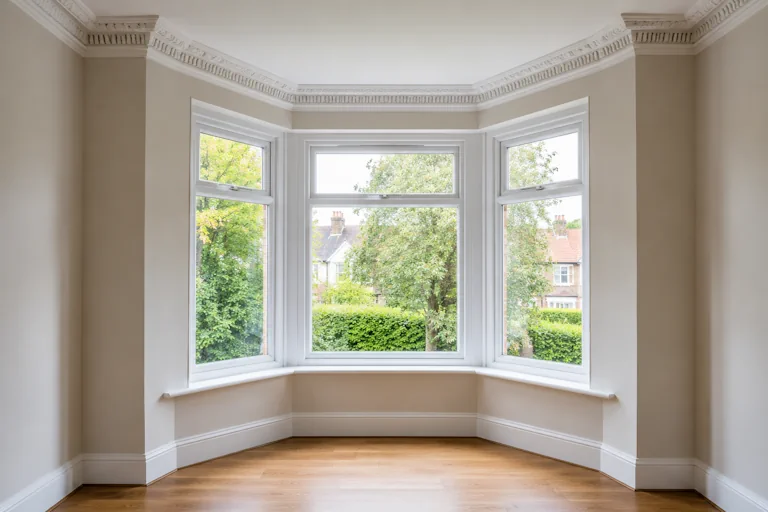
Having decorative coving elsewhere in the room is not normally a problem. The difficulty arises when the coving continues around the room and into the bay window at the same ceiling height.
The coving can occupy the space where a curtain track or its brackets would normally be fitted. It can also affect how far the return sections of the track sit away from the walls at each side of the bay.
This does not necessarily mean that you cannot fit a bay window curtain track. It means that the track position and fixing method need to be chosen around the shape of the coving and the way you want your curtains to hang.
Start with the Curtains, Not Just the Window Frame
The best track position is normally determined by the path the curtains need to follow. For long curtains, this will often mean positioning the track in front of the window sill rather than directly above the window frame.
This can naturally move the track far enough forward to avoid smaller decorative coving.
Learn why your curtain track may not follow the window frame exactly →
Fitting a Curtain Track in a Bay with Smaller Decorative Coving

Why Wall Fixing Above the Windows May Not Be Possible
Smaller decorative coving can be a lovely feature in a room. However, when it continues around and into a bay window, it can affect where the curtain track can be fitted.
The first place many people consider is the wall between the underside of the coving and the top of the window frames.
Unfortunately, many bay windows have very little wall available in this position, and sometimes none at all. This means there may not be enough space to attach wall brackets securely.
Ceiling Fixing Is Often the Best Solution
The next option is to ceiling fix the curtain track inside the bay. In many cases, this is actually the best solution, particularly when the bay has a deep window sill.
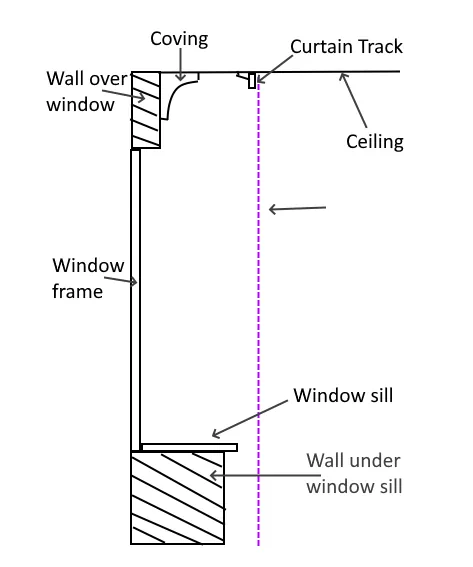
For floor-length curtains, the track should normally be positioned just in front of the front edge of the window sill.
This means the track will naturally sit some distance in front of the coving, allowing it to be fixed directly to the bay ceiling without the coving getting in the way.
Why This Position Works
The track is not being moved forward simply to avoid the coving. It is being positioned where the curtains need to hang so that they can clear the front of the window sill.
Avoiding the smaller decorative coving is often a natural result of choosing the correct curtain position.
What Happens When the Track Returns Out of the Bay?
The part that requires a little more thought is where the curtain track returns out of the bay and continues onto the walls at each side.
These return sections are important because they allow the curtains to close the gaps at the sides of the bay. Without them, you may be left with visible gaps between the curtains and the adjoining walls.
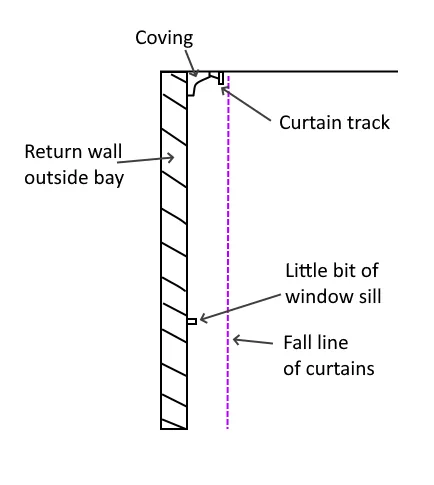
Where smaller decorative coving continues along the return walls, the track can normally remain ceiling fixed. It is positioned just in front of the coving in the same way as the track inside the bay.
Will the Curtains Sit Too Far Away from the Return Walls?
People often ask whether positioning the track in front of the coving will push the curtains too far away from the walls on the return sections.
The answer is yes, the curtains will sit slightly away from the return walls. However, with smaller decorative coving, the distance is not normally enough to create a visual problem.
The curtains may typically hang around 10 to 12 cm away from the wall. When viewed from the main part of the room, this usually looks perfectly natural.
The gap is most noticeable when the bay is viewed directly from the side, perhaps through a doorway positioned at right angles to the window. In most room layouts, this is not the main viewing angle.
What I Would Look for
I would check the depth of the coving, the position of the front edge of the window sill and the angle from which the bay is normally viewed.
With smaller coving, ceiling fixing the complete track usually provides the neatest and simplest solution while still allowing useful curtain returns at both sides.
Why Large Decorative Coving Usually Requires a Wall-Fixed Track
Why Is Large Coving Different?
Large decorative coving creates a different set of challenges. It will often prevent a bay window curtain track from being ceiling fixed successfully.
Interestingly, the main problem is not always inside the bay itself.
If the bay has a deep window sill, the track may already need to sit far enough into the room for the curtains to clear the sill. This can partly cancel out the depth of the coving.
If the window sill is shallow, the coving may force the track further into the room than is really necessary. This reduces the usable space inside the bay and places the curtains further away from the windows.
The Biggest Problem Is Usually on the Returns
To close the gaps at the sides of a bay window, the track would normally return out of the bay onto the adjoining walls.
With large decorative coving, a ceiling-fixed return would have to wrap around the front of the coving.
This can push the track and curtains a considerable distance away from the return walls. Instead of appearing connected to the window and walls, the curtains can begin to look as though they are floating out into the room.
At that point, the overall bay and curtain arrangement can start to look visually awkward.

Wall Fixing Is Usually the Neater Solution
More often than not, the best solution for a bay with large decorative coving is a wall-fixed curtain track.
This allows the track to sit below the coving rather than being forced around the front of it.
Is There Enough Wall Above the Windows?
Before choosing a wall-fixed bay track, you need to check that there is enough wall space between the underside of the coving and the top of the window frames or window recess.
The wall needs to provide enough room for the brackets to be fitted securely without fixing into the coving or overlapping the window frame.
If sufficient wall space is available, a wall-fixed track will usually keep the curtains much closer to the bay and return walls than a ceiling-fixed track positioned around the front of large coving.

How Does the Window Sill Affect the Length of the Curtains?
Once you have established that the track can be wall fixed below the coving, the next important question is the depth of the window sill.
The sill depth will often determine whether the curtains can hang in front of it and continue down towards the floor, or whether they should finish at the top of the sill.
Shallow Window Sills
A shallow window sill of only a few centimetres will normally cause very few problems.
The curtains can usually hang in front of the sill without being pushed noticeably into the room.
This means you may still be able to use floor-length curtains, provided there are no radiators or other obstructions below the window.

Deep Window Sills
A deep window sill is more difficult because it pushes long curtains further into the room.
In many bays with large decorative coving and deep sills, curtains that finish at the top of the window sill will provide the neatest result.
Trying to hang long curtains behind a deep sill will not work, while allowing the sill to push the curtains forward can distort the way they hang.
The projecting sill may also create gaps at the sides of the bay by pushing the outside edges of the curtains away from the walls.
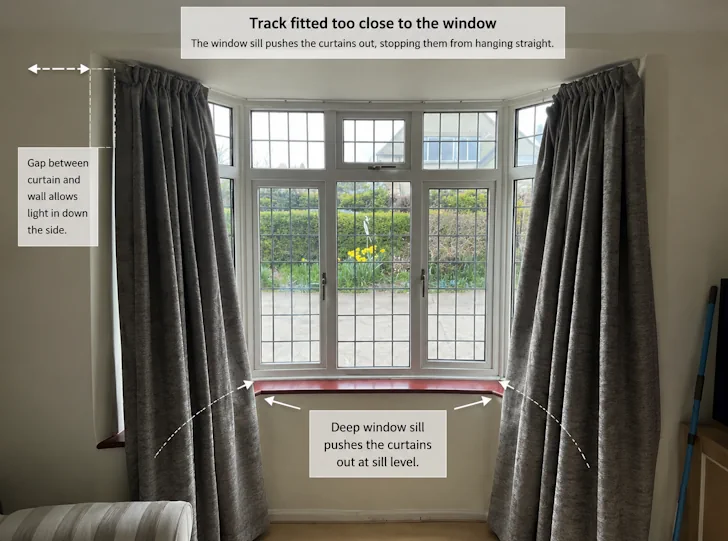
The Window Sill Often Becomes the Deciding Factor
Large coving may determine that the track needs to be wall fixed, but the window sill often determines how long the curtains can be.
A shallow sill may still allow floor-length curtains. A very deep sill will usually make curtains finishing at the top of the sill the more practical choice.
Can Longer Wall Brackets Bring the Curtains in Front of the Sill?
A common question is whether longer wall brackets can bring the curtain track far enough forward to clear a deeper window sill.
Longer brackets can help, but only up to a point.
We can normally provide a maximum wall bracket projection of approximately 10 cm. This may be enough to clear a medium-depth sill and allow the curtains to hang more naturally.
However, it will not completely solve the problem created by a very deep sill.
Even if the track is brought further forward, the sill may still push against the curtains. The deep sill can also leave gaps on the bay sides by forcing the curtains away from the return walls.

Longer Brackets Are Not an Unlimited Solution
Longer brackets can provide useful extra clearance for a medium-depth sill. They cannot always compensate for a very deep sill without moving the entire curtain track too far into the room.
In these situations, shorter curtains finishing at the top of the sill may give a better and more balanced result.
Things to Check Before Ordering Your Bay Curtain Track
Before deciding between a wall-fixed and ceiling-fixed bay track, look carefully at the complete window rather than the coving alone.
Check the Following
- Does the decorative coving continue all the way around and into the bay?
- How far does the coving project into the room?
- Is there enough wall between the underside of the coving and the top of the windows?
- Is the window sill shallow, medium depth or very deep?
- Do you want curtains that finish at the sill or continue down towards the floor?
- Is there enough space for the track to return onto the walls at both sides?
Common Mistakes When Planning a Bay Track Around Coving
Assuming the Track Must Follow the Window Frame
The position of the window frame does not always show where the curtains need to hang. The sill, coving and curtain returns must also be considered.
Trying to Wrap the Track Around Large Coving
Although it may be physically possible, wrapping a ceiling-fixed track around the front of large coving can push the curtains too far away from the return walls.
Assuming Longer Brackets Will Solve Every Deep Sill
Extended wall brackets can help with medium-depth sills, but very deep sills may still prevent long curtains from hanging neatly.
Does Decorative Coving Mean I Cannot Have a Bay Curtain Track?
Decorative coving does not automatically prevent you from fitting a curtain track in a bay window.
Smaller coving can often be avoided by ceiling fixing the track in front of it. Large decorative coving will usually need a wall-fixed track fitted below it.
The most important part is to consider the coving, wall space, window sill and intended curtain length together before deciding where the track should go.
With the right layout, most bays with decorative coving can still be fitted with a practical and attractive made-to-measure curtain track.
Not Sure Which Track Position Will Work?
Decorative coving and window sill depth are often easier to assess from photographs than from measurements alone.
Send us a clear photograph showing the complete bay window, including the coving, ceiling, window sill and the walls at both sides. We can then help you understand whether wall fixing, ceiling fixing or a combination of both would work best.
Photographing Your Bay Window
Stand far enough back to include the full width of the bay and the walls on both sides. It is also helpful to include the floor, ceiling and complete depth of the window sill.
Additional photographs taken from each side can help show how far the coving and window sill project into the room.