Awkward Bay Window Curtain Track Advice
Not every bay window is straightforward.
Some bay windows are beautifully designed but surprisingly difficult to fit with curtains. Deep bulkheads, decorative coving, changing ceiling heights, one-sided bays and limited wall space can all affect where a curtain track can be positioned.
TThe good news is that there is usually a practical solution. The important part is understanding the available options — and any compromises involved — before your curtain track is made.
This guide brings together real awkward bay window case studies, along with practical advice on many of the most common problems you may encounter when planning curtains for an unusual bay window.
Real Awkward Bay Window Case Studies
When you have an unusual bay window, it can be reassuring to see how other people have dealt with a similar problem.
These are genuine bay windows sent to me by customers. Each example shows the architectural features that made the window difficult, the curtain track options available and the solution I would recommend.
No two awkward bay windows are exactly the same. However, many share similar problems, including bulkheads, coving, deep window sills, unusual angles and limited space at the sides of the bay.
Lee’s Advice
Try not to decide where the curtain track should go simply by following the window frame. The best track position is normally determined by the ceiling shape, the available fixing surfaces and the space the curtains need to hang freely.
Case Study 1
Full-Length Curtains or Window-Sill-Length Curtains?
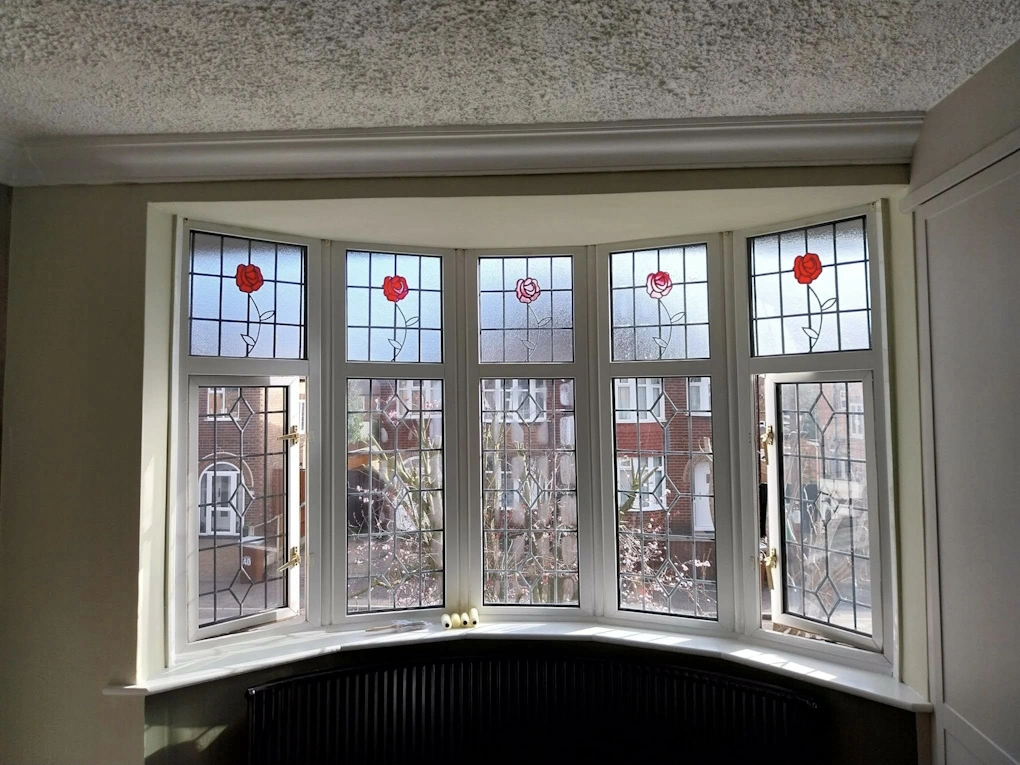
The Challenge
This bay window has been designed with several different angles, levels and projecting surfaces, making it particularly difficult to dress with curtains.
The deep bulkhead projects into the room, while the decorative coving occupies the area where a ceiling-fixed curtain track might normally be positioned.
The shape of the bay also changes between the top of the windows and the ceiling, which means the curtain track cannot simply follow the window frame.
The main decision is whether to fit the track to the front of the bulkhead for full-length curtains, or underneath the bulkhead for curtains that finish at the top of the window sill.
Why Is This Bay Window Difficult?
A curtain track needs a solid, reasonably flat fixing surface and enough clearance for the curtains to hang without rubbing against the windows, handles or sill.
In this bay, the decorative coving prevents the track from being fitted tight to the ceiling, while the bulkhead projects further into the room than the windows below.
There is also very little space at the outside edges of the bay for the track to return onto the adjoining walls.
This means there is no perfect position that gives both full-length curtains and long curtain returns at the sides.
What Are the Options?
Option 1 – Fit the Track to the Front of the Bulkhead
A made-to-measure curtain track can be wall-fixed to the vertical face at the front of the bulkhead.
This position allows the curtains to hang from near ceiling height down to just above the floor, creating the appearance of long, full-length curtains.
Fitting the track further forward also helps the curtains clear the window sill and the projecting parts of the bay.
However, the track cannot extend very far beyond the outside edges of the bay. This limits the length of the curtain returns and may leave a slight gap between the curtains and the side walls when they are closed.
Any small gap would be caused by the shape of the room rather than a fault with the curtain track.
Option 2 – Top-Fix the Track Underneath the Bulkhead
The second option is to top-fix the curtain track to the underside of the bulkhead, directly above the windows.
This allows the track to remain inside the bay and follow the shape of the windows more closely.
Curtains fitted in this position could only hang down to the top of the window sill. They would frame the windows rather than continuing down to the floor.
This can work well where shorter curtains are preferred, but it creates a very different appearance from full-length curtains fitted to the front of the bulkhead.
Which Option Would I Recommend?
For most customers, I would recommend fitting the curtain track to the front face of the bulkhead.
Although this means accepting the possibility of a small gap at each outside edge, it allows elegant full-length curtains and gives the room a taller, more balanced appearance.
If the customer prefers curtains that finish at the window sill, fitting the track underneath the bulkhead remains a practical alternative.
What I Saw as the Designer
When I first looked at this photograph, my attention went to the bulkhead and decorative coving rather than the window itself.
Those features immediately told me that a ceiling-fixed track positioned above the windows would not allow full-length curtains.
I then looked at the outside edges of the bay and saw that there was very little space for the track to return onto the side walls.
The real decision was therefore not whether a curtain track could be fitted, but which compromise would give the customer the best finished result.
Key Takeaway
When a bay window has a deep bulkhead and decorative coving, the best track position may not be directly above the window.
Fitting the track to the front of the bulkhead can allow full-length curtains, while fitting it underneath the bulkhead limits the curtains to the top of the window sill.
In either position, the architecture of the room may limit how far the track can return at the sides.
Case Study 2
When a Supporting Beam Prevents the Curtain Track Returning Out of the Bay
The Challenge
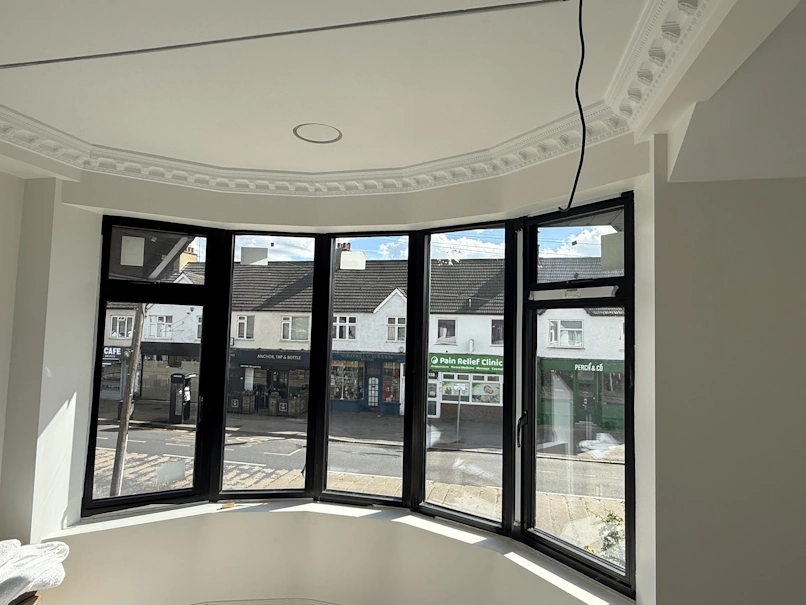
This is a seven-sided bay window with a large supporting beam running across the front, or mouth, of the bay.
The beam sits lower than the ceiling inside the bay, which prevents the curtain track from continuing beyond the bay and returning onto the adjoining walls.
The windows also extend too high to allow a wall-fixed curtain track to pass underneath the beam and then return out of the bay.
This type of beam-over-bay arrangement is quite common, but it can place some important limits on the curtain layout.
Why Is This Bay Window Difficult?
For floor-length curtains to work well, the curtain track normally needs to be positioned far enough forward for the curtains to clear the full depth of the window sill.
In this example, the track cannot return beyond the bay because the supporting beam blocks the route at both sides.
The window sill also projects further into the room at the outside edges. If long curtains were fitted to a track positioned inside the bay, the sill would push the outside edges of the curtains forward and leave noticeable gaps.
For that reason, the practical curtain options for this particular bay are limited to curtains that finish at the top of the window sill.
What Are the Options?
Option 1 – Ceiling Fix the Track Within the Bay
A made-to-measure curtain track can be top-fixed to the ceiling inside the bay and shaped to follow all seven sides.
The track would remain entirely within the bay because the supporting beam prevents it from extending onto the side walls.
Curtains fitted in this position should finish at the top of the window sill. This avoids the outside edges of the curtains being pushed forward by the projecting sill.
Ceiling fixing is often a neat option where there is a suitable solid fixing surface above the bay.
Option 2 – Wall Fix the Track Within the Bay
The second option is to wall-fix the curtain track above the windows while keeping the complete track inside the bay.
As with the ceiling-fixed option, the curtains would finish at the top of the window sill rather than continuing down to the floor.
The choice between wall fixing and ceiling fixing would depend on the available fixing surfaces, the preferred appearance and how much space is available above the window frames.
Option 3 – Create a False Ceiling Inside the Bay
In some beam-over-bay windows, it is possible to create a lower false ceiling inside the bay that aligns with the underside of the supporting beam.
This creates a new level fixing surface and allows the track to be ceiling-fixed within the bay before using wall-fixed returns to continue beyond the bay.
This can work particularly well where the window sill is deep. The track can be positioned further forward so the curtains hang in line with the front edge of the sill rather than being trapped behind it.
However, a false ceiling will only solve the problem if the tops of the windows sit below the underside of the supporting beam.
There must be enough space between the top of the window frames and the underside of the beam for the curtain track to pass through and continue onto the side walls.
If the windows extend as high as the beam, as they do in this example, the false ceiling option will not create enough room for the track to return out of the bay.
Which Option Would I Recommend?
For this particular bay, I would recommend keeping the curtain track entirely within the bay and hanging the curtains to the top of the window sill.
The track could be either wall-fixed or ceiling-fixed, depending on the available fixing surfaces and the customer’s preferred appearance.
Because the windows extend too high beneath the supporting beam, there is no practical route for the track to return beyond the bay without altering the windows or the main structure.
What I Saw as the Designer
My attention went straight to the supporting beam across the front of the bay.
Once I saw that the beam sat lower than the ceiling inside the bay, I knew it would prevent the curtain track from returning onto the adjoining walls.
The next thing I checked was the height of the windows. Because the window frames extend almost up to the underside of the beam, there is no space for a wall-fixed track to pass underneath it.
The projecting window sill then ruled out floor-length curtains, as it would push the outside edges of the curtains forward and leave gaps.
Key Takeaway
A supporting beam across the front of a bay window can prevent the curtain track from returning out of the bay.
Where the windows extend close to the underside of the beam, the track will usually need to remain inside the bay and the curtains will normally finish at the top of the window sill.
A false ceiling may create another option, but only where the tops of the windows sit below the underside of the beam and leave enough clearance for the track.
Case Study 7
When Double Bay Curtain Tracks with Floor-Length Curtains Are Not Practical
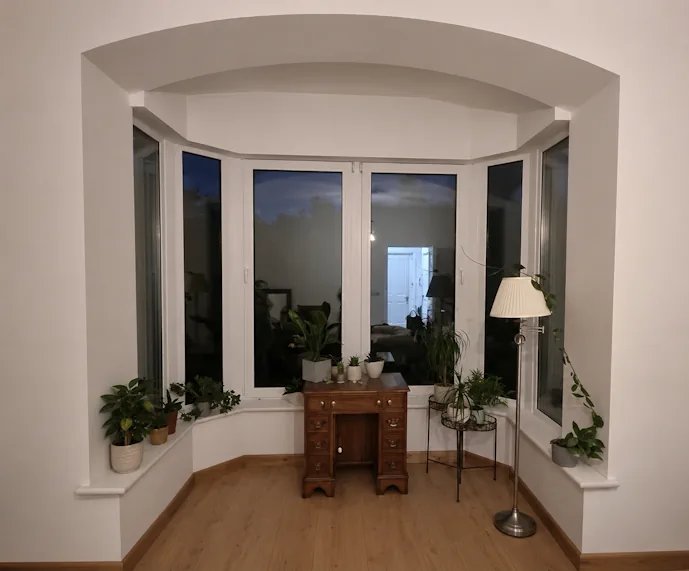
The Challenge
This is a very attractive bay window, but it contains several architectural features that make it particularly difficult to dress with curtains.
The customer wanted two bay curtain tracks: one for the main curtains and another for a lighter curtain or sheer.
They also wanted both sets of curtains to hang in front of the window sill and continue down towards the floor.
At first glance, the bay may not appear unusually difficult. However, a closer look reveals an arched beam across the front, several different wall levels, a projecting window sill and inward-opening tilt-and-turn windows.
Individually, each of these features might be manageable. The problem was that every possible track position solved one issue while creating another.
Why Is This Bay Window So Difficult?
1. The Arched Beam Across the Front of the Bay
A large arched beam runs across the front, or mouth, of the bay.
This limits where the tracks can pass out of the bay and makes it difficult to create normal curtain returns onto the adjoining walls.
The curved underside of the arch also prevents it from providing a straightforward, level fixing surface for two curtain tracks.
2. Several Different Wall Levels
The walls around the bay do not form one continuous fixing line.
Different sections sit at different depths, so a wall-fixed track following the shape of the bay would not remain the same distance from the windows throughout.
To complete the bay properly, the brackets would need two different projections.
One section of the track would need to sit closer to the wall, while another section would need to project further into the room to keep the curtain line consistent.
There are no standard double bay curtain track brackets designed to achieve these two different projections within the same installation.
3. The Depth of the Window Sill
The projecting window sill creates another obstacle for floor-length curtains.
To hang freely down the front of the sill, both curtain tracks would need to be positioned far enough into the room for the curtain folds to clear it.
Moving one track far enough forward can be difficult. Moving two parallel tracks forward while maintaining enough space between the curtains requires considerably more room and stronger support.
The changing wall levels meant that the required projection could not be achieved evenly around the bay using available double-track brackets.
4. Inward-Opening Tilt-and-Turn Windows
The windows open inwards into the room rather than opening outwards.
Tilt-and-turn windows need clear space in front of the frames so the opening sections can swing into the room.
A curtain track fitted too close to the windows could prevent them from opening fully or cause the window to strike the track, brackets or curtains.
Moving the tracks further forward would provide more window clearance, but this would increase the required bracket projection and make the problems caused by the deep sill and changing wall levels even greater.
Could the Individual Problems Be Solved?
If this bay only had an arched beam, there might have been a way to design the tracks around it.
If it only had a deep window sill, longer wall brackets might have moved a track far enough forward for longer curtains.
If the only issue was the inward-opening windows, the track position might have been adjusted to provide the necessary clearance.
The difficulty was that all of these features existed together.
Every time one problem was addressed, the proposed track position became unsuitable for another reason.
What Track Layouts Did I Consider?
Ceiling Fixing Two Tracks Within the Bay
Ceiling fixing would normally be my preferred method for a complicated bay window.
However, the changing ceiling and wall levels did not provide a simple continuous fixing line for two parallel tracks.
Keeping the tracks inside the bay would also position the curtains too close to the projecting sill for the requested floor-length curtains.
Wall Fixing Two Tracks Above the Windows
Wall fixing initially appeared to offer another possibility.
However, the tracks would require two different bracket projections to negotiate the changing wall levels while keeping the curtains on a consistent line.
There are no suitable double curtain track brackets capable of providing this arrangement.
The tracks would also need to project far enough forward to clear both the deep sill and the inward-opening windows.
Using Longer or Specially Made Brackets
In theory, specially made brackets could move sections of the tracks further into the room.
In practice, this would create a complicated and visually heavy support structure around an otherwise attractive window.
The increased projection would also place greater leverage on the brackets and their wall fixings, particularly with two sets of curtains hanging from them.
I did not believe this would provide a neat, secure or satisfactory long-term installation.
Which Option Would I Recommend?
After considering every practical layout, I could not recommend fitting double bay curtain tracks with floor-length curtains to this window.
The arched beam restricted the route out of the bay, the different wall levels required two bracket projections, the sill demanded that the curtains sit further forward and the inward-opening windows required additional operating clearance.
Taken together, these features removed every track position that I felt would both work properly and look right.
Rather than supply a complicated installation that I believed might disappoint the customer, I felt it was better to explain honestly why their preferred curtain arrangement was not practical.
In a situation like this, I would recommend reconsidering the required curtain length, the need for two separate tracks or whether another type of window covering would suit the bay more successfully.
What I Saw as the Designer
When I first looked at this photograph, I saw a very attractive and carefully finished bay window.
I then noticed the arched beam across the front of the bay and began looking for a possible route for the curtain tracks.
Next, I saw that the walls and fixing surfaces sat at several different levels. This meant that a wall-fixed track would need more than one bracket projection to maintain a consistent curtain line.
The deep sill then showed that the tracks would need to sit well forward for floor-length curtains.
Finally, the inward-opening tilt-and-turn windows introduced another area that the tracks and curtains needed to avoid.
By the time I had worked through all four features, I was no longer looking for the perfect track layout. I was trying to find any double-track arrangement that would operate reliably without looking over-engineered.
In the end, I concluded that the room itself would not accommodate the result the customer wanted.
Key Takeaway
Some awkward bay windows are not made difficult by one major obstacle, but by several smaller restrictions working together.
An arched beam, changing wall levels, a deep sill or inward-opening windows may each be manageable on their own.
When they all appear in the same bay, they can remove every practical position for double tracks and floor-length curtains.
Good bay window advice is not about claiming that every idea can be achieved. Sometimes the most useful advice is recognising when a proposed installation is unlikely to operate properly or give an attractive finished result.
Case Study 4
When the Curtain Track Has to Be Fitted in Front of the Coving
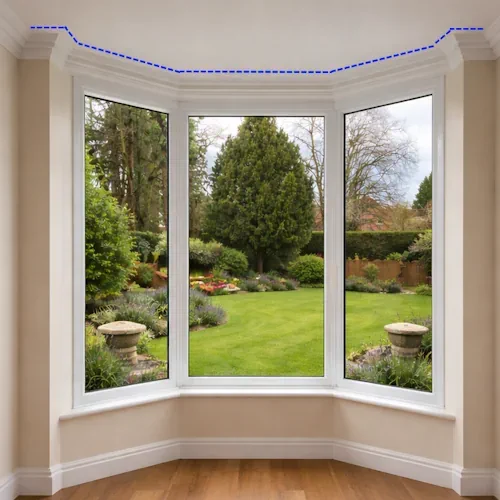
The Challenge
This bay window has no usable wall space above the window frames.
Decorative coving also continues around the inside of the bay and then onto the adjoining walls outside it.
This removes the usual option of wall fixing a curtain track above the windows.
Although it may be technically possible to fix a track directly to the window frames, this is not something I would normally recommend.
The best and only practical option is to ceiling fix the curtain track in front of the coving.
Why Is This Bay Window Difficult?
A curtain track normally needs either a suitable ceiling surface above the bay or a solid wall area above the windows.
In this case, there is no wall above the window frames, while the coving occupies the ceiling area where the track might otherwise be positioned.
The track also needs to continue beyond the bay and return onto the adjoining walls at both sides.
Keeping the complete track inside the bay would leave the outside edges of the curtains too far away from the side walls.
When the curtains were closed, this would create large gaps down both sides of the bay.
Why I Would Not Recommend Fixing the Track to the Window Frames
Fixing the curtain track directly to the window frames may appear to be the most obvious solution.
However, it can position the curtains too close to the windows, restrict the operation of opening sections and make it more difficult to create effective curtain returns.
It may also involve drilling into the window frames, which could cause damage or affect any existing guarantees.
For these reasons, I would prefer to use the surrounding building structure wherever a practical alternative is available.
What Is the Recommended Layout?
Ceiling Fix the Track in Front of the Coving
The curtain track would be ceiling fixed in front of the coving across the complete bay.
This position may initially sound unusual, but it actually works very well in this type of window.
Fitting the track in front of the coving brings it far enough into the room for the curtains to clear the window sill.
This allows the customer to hang longer curtains, including curtains that finish below the sill or continue down towards the floor.
Return the Track Out of the Bay on Both Sides
At each end, the track should continue out of the bay and return onto the adjoining walls.
The returns would also sit in front of the coving.
This is necessary when hanging curtains in a bay window of this type.
Without the returns, the curtains would stop close to the mouth of the bay and leave large gaps down both sides when closed.
Extending the track beyond the bay allows the outside edges of the curtains to sit much closer to the side walls.
It also provides more space for the curtains to stack away from the side windows when they are open.
Will a Track in Front of the Coving Look Unattractive?
Many customers are understandably concerned that fitting a curtain track in front of decorative coving will look awkward or spoil the appearance of the room.
In reality, the finished result normally looks much better than people expect.
The track may appear noticeable while the room is empty, but once the curtains are hanging, your attention is naturally drawn to the curtains and the overall shape of the bay.
The track and brackets then become far less visually prominent.
Although fitting a curtain track in front of decorative coving may initially sound like an unattractive compromise, the finished result can look neat, balanced and entirely natural.
What Is the Main Compromise?
The main downside is that the returns also sit in front of the coving.
This brings the outside edges of the curtains slightly further into the room than they would normally sit.
In most rooms, this is a fairly small compromise and is unlikely to be noticeable when looking directly towards the bay.
It may be more apparent where someone enters the room from the side, close to one end of the bay.
From that angle, it may be possible to see down the outside edge of the curtains and notice how far the return projects into the room.
Even so, I believe this is a small price to pay for achieving long curtains, better side coverage and a properly dressed bay window.
Which Option Would I Recommend?
I would recommend ceiling fixing the curtain track in front of the coving and returning it out of the bay on both sides.
This is the only practical layout that allows the track to avoid the window frames, clear the projecting sill and give the curtains enough coverage at the sides.
Positioning the track in front of the coving allows longer curtains to hang neatly in front of the window sill.
The returns reduce the large side gaps that would otherwise appear and help the curtains stack further away from the side windows.
Although the returns bring the curtains slightly further into the room, I believe this is a worthwhile compromise for the much better overall result.
What I Saw as the Designer
The first thing I noticed was that there was no wall above the windows.
I then saw that the coving continued both around the bay and onto the adjoining walls.
That ruled out a conventional wall-fixed curtain track and left very few sensible fixing positions.
Fixing directly to the window frames was technically possible, but it was not an option I felt comfortable recommending.
I then looked at the depth of the window sill and saw that the track needed to sit further forward if the customer wanted long curtains.
The only layout that allowed the curtains to clear the sill and close neatly against the sides of the bay was to ceiling fix the track in front of the coving and continue the returns beyond the bay.
Key Takeaway
Decorative coving does not always prevent a bay window from having long curtains.
Where there is no wall above the windows, fitting the curtain track in front of the coving may be the only practical solution.
Returning the track out of the bay on both sides is equally important, as it reduces side gaps and gives the curtains more room to stack away from the windows.
Although the track and returns sit slightly further into the room, the finished result often looks much better than customers expect.
Case Study 5
When a Wardrobe Prevents the Curtain Track Returning on One Side
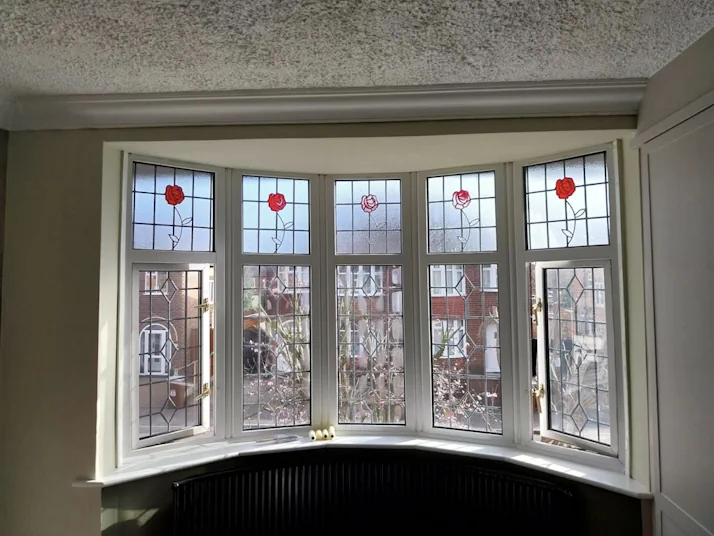
The Challenge
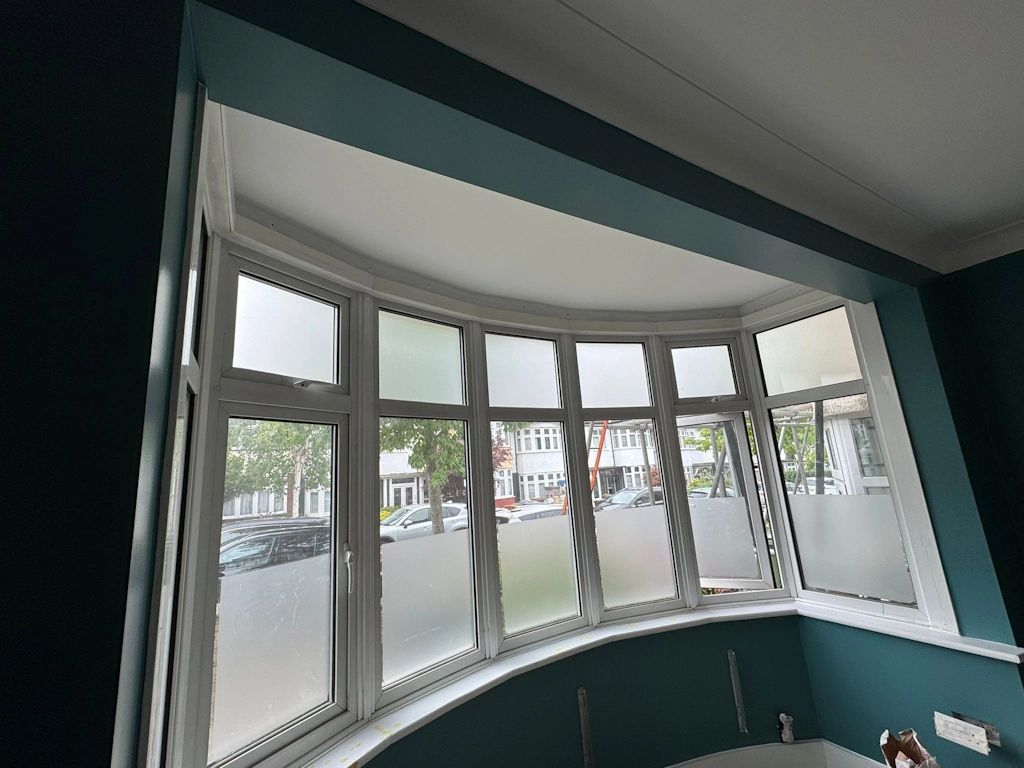
This bay window has a fitted wardrobe built tight against the right-hand side of the bay.
The wardrobe fills the wall space that would normally be used for the curtain track to return out of the bay. This means a conventional right-hand return is not possible.
There is still enough space on the left for the track to extend beyond the bay by approximately 20cm. However, the finished curtain track layout cannot be perfectly symmetrical.
The main decision is whether to keep the curtains entirely within the bay, or position them in front of the window sill and create the best possible return arrangement using the space available.
Why Is This Bay Window Difficult?
Curtain returns help the curtains close against the adjoining walls, reduce gaps at the sides and provide somewhere for the curtains to stack when they are open.
In this bay, the wardrobe completely removes the space required for a normal return on the right.
The window sill is also not perfectly level. This creates another consideration if the curtains are designed to finish at sill height, as the gap beneath the curtains may appear uneven.
Neither curtain layout is completely without compromise. The best option depends on whether the priority is symmetry, curtain length, light control or the overall finished appearance.
What Are the Options?
Option 1 – Keep the Curtains Entirely Within the Bay
The first option is to keep the complete curtain track inside the bay and hang curtains that finish at the top of the window sill.
This creates a more balanced track shape because neither side needs to extend very far beyond the bay.
However, the uneven window sill creates a potential visual problem. Even if the curtains are made to the same finished length, the gap between the bottom of the curtains and the sill may vary across the window.
The curtains will also stack within the bay when they are open, which means they may cover more of the glass and reduce the amount of daylight entering the room.
Option 2 – Hang the Curtains in Front of the Window Sill
The second option is to position the curtain track far enough forward for the curtains to hang in front of the window sill.
The curtains could finish just below the sill or continue down to the floor, depending on the customer’s preferred style.
On the left, the track would return out of the bay by approximately 20cm. This would allow the curtain to close more securely against the wall and provide additional space for it to stack away from the window.
A conventional return cannot be added on the right because the fitted wardrobe occupies the necessary wall space.
Instead, the track would be made with a slight outward curve as it approaches the wardrobe. The end of the track would then butt against the plinth above the wardrobe door.
When closed, the right-hand curtain would follow this curve and sit closely against the edge of the wardrobe. This is the only practical way to bring the curtain forward while working around the existing furniture.
Which Option Would I Recommend?
I would recommend hanging the curtains in front of the window sill.
Although the track would return further on the left than on the right, I believe this gives the best overall appearance.
Longer curtains would conceal the uneven window sill rather than drawing attention to it. The left-hand return would also improve light control on that side and allow more of the curtain to stack away from the glass when open.
The right-hand curtain would need to finish against the edge of the wardrobe, but the slight curve in the track would help it sit neatly in the available space.
Some customers are understandably concerned that the window may look unbalanced without matching returns. However, the finished curtains are normally more important visually than the track shape itself.
What I Saw as the Designer
My attention went immediately to the wardrobe fitted against the right-hand side of the bay.
Once I saw that it filled the available wall space, I knew there could be no conventional curtain return on that side.
I then looked at the window sill and noticed that it was not level. This made sill-length curtains less attractive because the varying gap beneath them could become noticeable.
The left side still had enough wall space for a useful return, so I would make use of it rather than shortening both sides simply to create a more symmetrical track.
In an awkward bay, the most balanced-looking track layout is not always the layout that gives the best-looking curtains.
Key Takeaway
A fitted wardrobe or other piece of permanent furniture can prevent a curtain track from returning out of one side of a bay window.
The track does not always need matching returns at both ends. A longer return can be used where space allows, while the opposite end can be curved carefully towards the obstruction.
Although an asymmetrical track may initially seem less balanced, it can still produce the best overall curtain layout, particularly where longer curtains help conceal an uneven window sill.
Case Study 6
When a Sloping Ceiling Makes Wall Fixing the Best Option
“`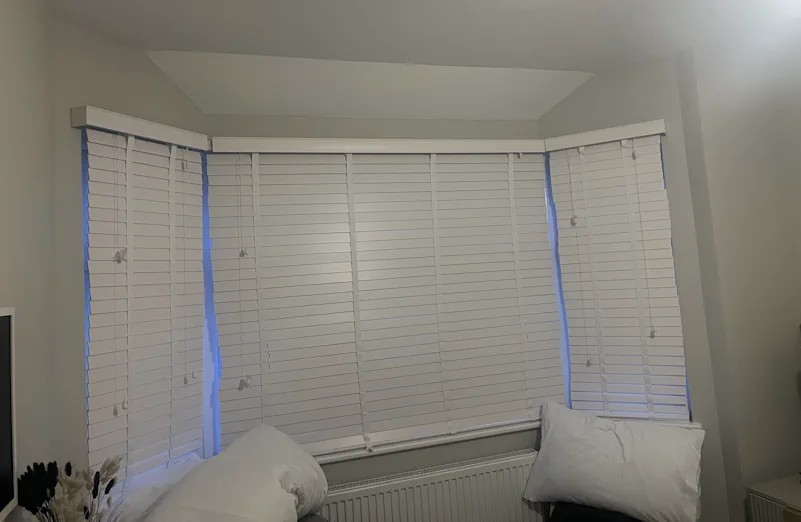
The Challenge
This bay window has a sloping ceiling that follows the roofline above the windows.
Although I normally recommend ceiling fixing a bay window curtain track whenever possible, a track needs a reasonably flat fixing surface so it can sit correctly against the ceiling.
The slope in this bay means the track cannot be fitted flush to the ceiling, making ceiling fixing impractical.
Fortunately, the window sill is not particularly deep. This means the track can be wall fixed above the windows and still position the curtains far enough forward to hang neatly.
Why Is This Bay Window Difficult?
The sloping ceiling removes the fixing method I would normally prefer for a bay window.
The bay also has blinds fitted close to the windows. If the curtain track were fitted using short standard brackets, the curtains could hang too close to the blinds and rub against them whenever they are opened or closed.
The important decision is therefore not simply whether to wall fix the track, but how far the brackets need to project from the wall.
The track must sit far enough forward for the curtains to clear the blinds while still looking neat and remaining securely supported.
What Are the Options?
Option 1 – Wall Fix the Track Using Standard Brackets
Standard wall brackets usually project approximately 3cm to 5cm from the wall.
This amount of projection is suitable for many straightforward windows where there are no blinds, deep handles or other obstructions behind the curtains.
On this particular bay, however, the standard brackets would position the track too close to the blinds.
The curtain folds could rub against the blinds, making the curtains more difficult to operate and potentially causing wear over time.
Option 2 – Wall Fix the Track Using Longer Projection Brackets
The better option is to use longer wall brackets that move the curtain track further away from the windows.
For our Regular Bay Curtain Track, I would recommend using the 5.5cm projection brackets.
For our Slimline Bay Curtain Track, I would recommend using the 7.5cm wall brackets.
This additional projection provides more clearance between the curtains and the blinds, allowing the curtains to hang and operate more freely.
I would also recommend returning the curtain track out of the bay on both sides.
The returns provide additional space for the curtains to stack away from the side windows when open, allowing more daylight into the room.
If the bay is in a bedroom, the returns can also help reduce light entering around the outside edges of the curtains when they are closed.
What If the Bay Also Has a Deep Window Sill?
This particular bay has a fairly shallow window sill, which allows the curtains to hang in front of it from a wall-fixed track.
However, if your bay has both a sloping ceiling and a much deeper window sill, the available curtain options become more limited.
The track would still need to be wall fixed because the sloping ceiling prevents ceiling fixing.
In most cases, the curtains would then need to finish at the top of the window sill rather than continuing down in front of it.
Customers sometimes ask whether very long wall brackets could simply move the track further into the room so longer curtains can clear the sill.
Although longer brackets are available, there are practical limits to how far a curtain track should project from the wall.
For our Regular Bay Curtain Track, the maximum wall bracket projection is approximately 8cm.
For our Slimline Bay Curtain Track, the maximum wall bracket projection is approximately 10cm.
Even if brackets with a much greater projection were available, I would not recommend using them.
The further the track projects from the wall, the greater the leverage acting on both the brackets and their fixings. With medium-weight curtains, excessively long brackets can begin to flex or sag and place unnecessary strain on the wall fixings.
There is also the question of appearance.
A curtain track fitted on brackets projecting 15cm or 20cm into the room would begin to look more like an engineering structure than a carefully designed window treatment.
One of the aims of a well-planned bay curtain track is for the track and brackets to remain visually unobtrusive once the curtains are hanging. Extremely long brackets would look bulky and could dominate the window.
For that reason, where a bay window has both a sloping ceiling and a deep projecting sill, I would normally recommend wall fixing the track with suitable brackets and hanging the curtains to the top of the window sill.
Which Option Would I Recommend?
For this particular bay, I would recommend wall fixing the curtain track using longer projection brackets.
The sloping ceiling makes ceiling fixing unsuitable, while the relatively shallow window sill allows the curtains to hang comfortably in front of it.
The longer brackets will position the curtains far enough forward to clear the blinds without making the installation look unnecessarily bulky.
Returning the track out of the bay on both sides will also allow more of the curtains to stack away from the side windows and improve light control when the curtains are closed.
What I Saw as the Designer
The first thing I noticed was the sloping ceiling.
That immediately ruled out ceiling fixing because the curtain track would not sit flat against the angled surface.
I then looked at the depth of the window sill. Because it projects only a short distance into the room, I knew a wall-fixed track could still position the curtains correctly.
The next detail I checked was the blinds. These showed that standard wall brackets would not provide enough clearance for the curtain folds.
The solution was therefore to wall fix the track using slightly longer brackets and make use of the available wall space at both sides for the curtain returns.
Key Takeaway
A sloping ceiling does not prevent a bay window from having a made-to-measure curtain track.
It simply means that wall fixing may be a better option than ceiling fixing.
Where the window sill is shallow, longer projection brackets can bring the curtains forward to clear blinds and other obstructions.
Where the sill is much deeper, sill-length curtains are often the most practical choice. Trying to use extremely long brackets can create problems with strength, stability and appearance.
More Advice About Awkward Bay Windows
The case studies above show how these problems appear in real homes. The guides below explain each issue in more detail and help you understand what may be possible in your own bay window.
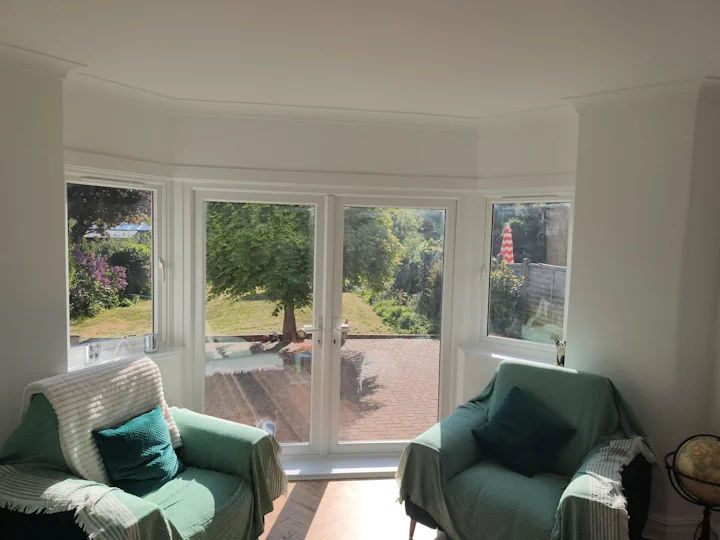
Why Doesn’t My Bay Window Look the Same at Ceiling Height?
Find out why the shape and measurements of a bay window can change between the window sill and the ceiling.
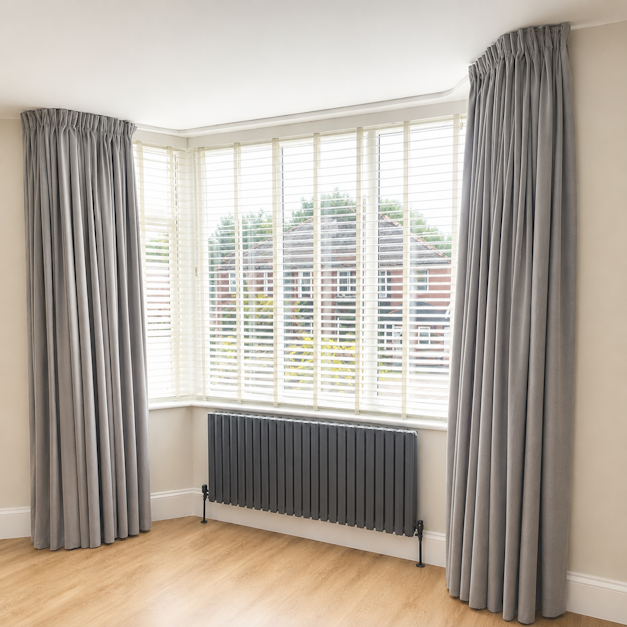
Why Can’t My Curtain Track Follow the Window Frame Exactly?
Understand why a curtain track sometimes needs to be positioned away from the glass or window frame.
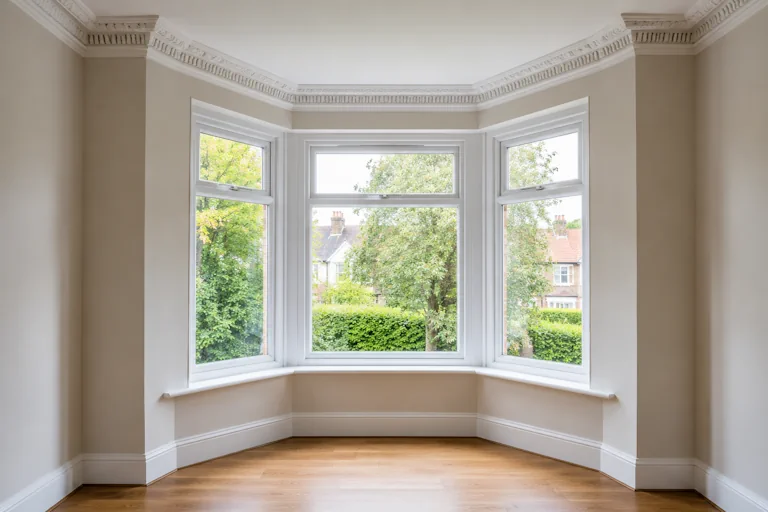
How Can I Fit a Curtain Track in a Bay Window with Decorative Coving?
Decorative coving doesn’t always prevent you fitting a bay window curtain track.
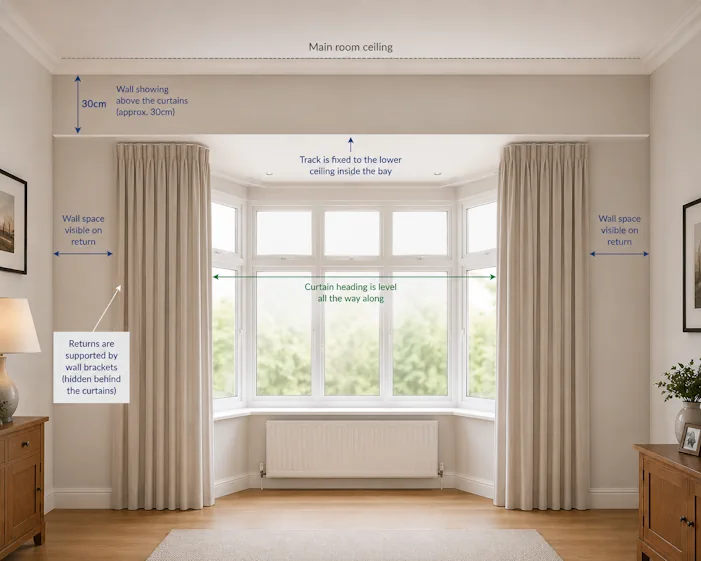
How Can I Fit a Curtain Track When the Bay Ceiling Is Lower Than the Rest of the Room?
Many bay windows have a ceiling that is lower than the rest of the room. So how do you do you fit a bay track properly.
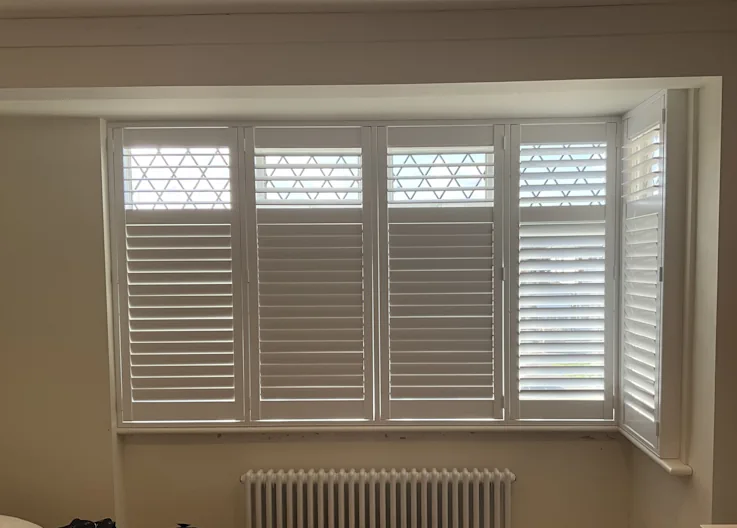
How Do I Hang Curtains in a One Side Bay Window?
Learn the best way to hang curtains in a one side bay window.
Not Sure What Will Work in Your Bay Window?
Awkward bay windows are often easier to understand from photographs than measurements alone.
Send us a clear photograph showing the whole bay window, including the ceiling, window sill and the walls at both sides. We can then help you understand where the curtain track could be fitted and whether there are any compromises to consider.
Photographing Your Bay Window
Stand far enough back to include the full width of the bay, the ceiling above it and the floor below. Additional photographs from each side can also help reveal changes in the wall or ceiling shape.
Still Unsure then Let Us Help You
Let the curtain track finder help you decide which track is best for your window. Or you can get advice on how to deal with your bay window by send a couple of photos.